Czech Media Funding Protest Raises Wider Concerns for EU Investors
A proposed shift to state-budget funding has sparked a vast Prague protest and renewed European concerns over media independence.
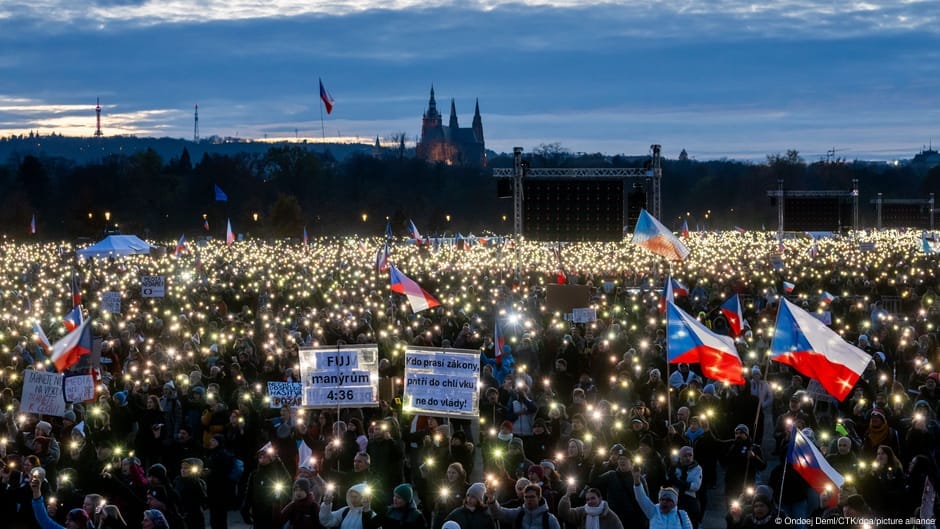
Hundreds of thousands of people demonstrated in Prague on Sunday, November 15, against Czech government plans to change the way public-service broadcasters are financed, turning a domestic dispute into a wider test of institutional stability in the European Union.
Organisers estimated that roughly 400,000 people joined the anti-government rally, according to Reuters. If confirmed, the turnout would make it one of the Czech Republic’s largest protest actions since the Velvet Revolution.
The dispute centres on a proposal to abolish monthly household licence fees for public radio and television and replace them with funding allocated through the state budget. Critics argue that the change would leave broadcasters more exposed to political pressure and could threaten both their independence and their continued operation.
“An elected government has the right to govern the country. But it does not have the right to do whatever it wants and dismantle democratic institutions,” protest organiser Mikuláš Minář was quoted by Reuters as saying.
Minář chairs Milion Chvilek, the civic initiative that organised the demonstration. Activists are demanding that the authorities either withdraw the legislation or involve independent experts who can propose meaningful safeguards against political interference.
Institutional risk enters the European business debate
For British and European businesses, the confrontation matters beyond the Czech media sector. The Czech Republic is an EU member integrated into European manufacturing, investment and supply chains, and disputes over democratic checks can affect perceptions of regulatory predictability and institutional risk.
The source material reported no specific reaction in sterling or London-listed shares. The immediate implications for UK markets are therefore indirect rather than a documented currency or equity move. Even so, London investors with exposure to Central Europe will be watching whether the dispute remains a contained legislative battle or develops into a broader confrontation over governance.
The proposed law has drawn additional criticism because of the way governing parties advanced it. The bill was unexpectedly introduced for its first reading on Friday, October 23, outside the planned parliamentary schedule, with a vote set for the same night. Such overnight proceedings are highly unusual in Czech political life.
The Prague demonstration, held at the Letná grounds, was consequently named “Letná against 4:36,” referring to the time scheduled for the vote. Civil-society groups and opposition parties say the compressed process is particularly troubling because the legislation could reshape institutions expected to scrutinise those in power.
The governing coalition consists of right-wing and populist parties and leads an administration headed by billionaire Andrej Babiš. Coalition representatives, including the anti-immigration Freedom and Direct Democracy party, or SPD, have previously criticised media coverage of their activities, Reuters noted.
Broadcasters warn of a 15% funding reduction
Czech public-service media are currently financed through monthly household charges totalling 205 Czech crowns, equivalent to about €8.50. Babiš says abolishing those fees would fulfil an election promise to reduce the financial burden on citizens.
Broadcasters contend that the alternative would carry a substantial financial cost. Moving to direct budget financing would cut the funds available to them by 15%, according to the source article. In nominal terms, television funding would fall back to its 2008 level, while radio funding would return to the level recorded in 2005, despite increases in operating costs since then.
Television and radio companies have called that outcome unacceptable. Public broadcasters staged a strike in early November and restricted their output to draw attention to the proposed changes.
The economic argument therefore extends beyond the immediate saving for households. A lower nominal budget could force reductions in programming, staffing or other operations, while annual reliance on government allocations could create continuing uncertainty over broadcasters’ resources. The article does not provide estimates for employment losses or the wider commercial effect, and no such figures have been announced in the source.
The Czech opposition has compared the proposals with developments in Hungary under Prime Minister Viktor Orbán, where it says the authorities brought public-service media under government control. That comparison will resonate in Brussels, where institutional independence within member states has become a recurring political and legal concern.
For the EU, the controversy presents a familiar tension between an elected government’s fiscal mandate and the safeguards surrounding independent public institutions. For the UK, which remains economically connected to the bloc despite Brexit, any sustained deterioration in confidence across European markets can matter through trade, investment sentiment and regional risk pricing.
The next stage depends on whether the Babiš government presses ahead, withdraws the bill or accepts expert involvement and stronger guarantees. Until then, the scale of the Prague protest signals that the financing of Czech broadcasting has become a much broader confrontation over democratic accountability, with potential relevance for policymakers and investors across Europe.



