Kyiv and Crimea Bridge Strikes Raise European Trade and Market Risks
Renewed attacks on strategic crossings highlight infrastructure threats with implications for European logistics, energy costs and investor sentiment.
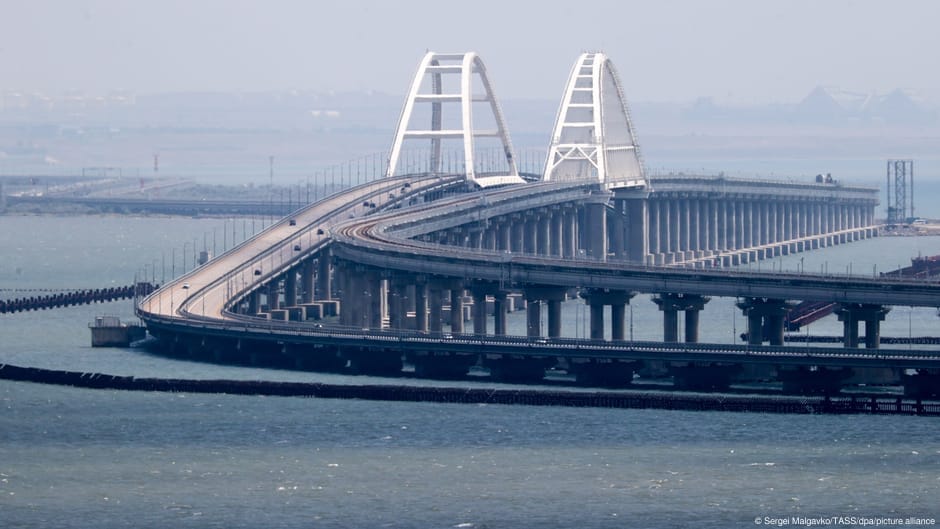
Russian forces struck two major bridges across the Dnipro in Kyiv overnight on Tuesday, November 17, while the bridge linking Russia with annexed Crimea was again targeted, underscoring the growing vulnerability of transport infrastructure on both sides of the war.
For British and European businesses, the attacks add another layer of uncertainty around Ukrainian supply chains, reconstruction costs and regional risk. The immediate market implications remain difficult to quantify because the extent of the damage has not been independently established and no verified information about a sustained disruption to cross-border trade has been reported. Nevertheless, London investors will be watching for any wider effect on energy markets, agricultural commodities and sterling-sensitive companies with exposure to continental Europe.
Kyiv was among the main targets of Russia’s latest large-scale overnight assault on Ukraine. Reports from the capital said ballistic missiles had struck the Northern and Southern bridges, two important routes connecting districts on opposite banks of the Dnipro.
Social-media users published photographs and video showing at least one explosion near the Northern Bridge. Local Telegram channels also reported interruptions to water and heating supplies in parts of the city situated on the eastern bank of the river.
Kyiv authorities said traffic across both the Northern and Southern bridges had been temporarily suspended.
Mayor Vitali Klitschko gave what he described as preliminary confirmation of strikes on both bridges, as well as water and heating disruptions in several districts. His brief notices provided no detailed assessment of casualties or structural damage.
The Kyiv Metro said on the morning of November 17 that services had stopped on the section of the green line that crosses the Dnipro using the Southern Bridge. City officials separately announced the temporary closure of road traffic on the Northern and Southern crossings.
Transport disruption deepens European business concerns
Russian forces have repeatedly attacked transport crossings in Kyiv since the beginning of October 2026. The campaign has prompted municipal and national authorities to consider alternative ways of maintaining connections across the Dnipro, a central logistical challenge for a capital divided by one of Europe’s largest rivers.
Options have included pontoon crossings, while a tunnel beneath the Dnipro has also been considered as a longer-term solution, according to an earlier statement by Ukraine’s minister for restoration, infrastructure and transport, Mykola Kalashnyk.
The repeated targeting of bridges is relevant to European governments and companies involved in supporting Ukraine and planning its eventual reconstruction. Any prolonged restriction on urban transport can raise delivery costs, disrupt labour mobility and complicate the movement of equipment and essential supplies. It may also increase the scale and urgency of future demand for European engineering, construction and infrastructure-finance capacity.
For the UK, the principal near-term financial channels run through changes in regional risk appetite and commodity prices rather than direct bilateral trade. A broader escalation could support demand for perceived safe-haven assets while weighing on sterling if investors become more cautious about European growth. However, the reports did not provide verified market-price movements, and the limited information on physical damage makes it premature to attribute a specific London trading response to the attacks.
Crimea crossing attacked for second consecutive night
In the Kerch Strait, Sergei Aksyonov, the Russia-appointed head of annexed Crimea, reported an attack on the bridge connecting the peninsula with Russian territory. He said traffic across the Crimea Bridge had been suspended and promised further information as the situation developed. Several hours after the attack, however, he had issued no additional public update.
The bridge had also been targeted during the preceding night. Traffic was closed until the evening of November 16. The Telegram channels Astra, Mash and Exilenova+ reported that one of the bridge’s arches had been damaged, but that claim had not received official confirmation.
The Crimea Bridge has repeatedly come under Ukrainian military attack since Russia began its full-scale invasion of Ukraine. The first major incident occurred in October 2022 and the second in July 2023, with both causing serious damage.
In June 2025, Ukraine’s Security Service said it had conducted an underwater operation to blow up the structure’s supports. No significant consequences from that operation were subsequently reported.
For European markets, the latest incidents reinforce the possibility that transport infrastructure will remain a central target as the conflict continues. The business impact will depend on whether closures prove temporary or develop into longer disruptions affecting military logistics, civilian movement or Black Sea supply routes.
London-listed defence, engineering, energy and commodity-related companies may be especially sensitive to signs of escalation, while sterling’s response would probably depend on the wider effect on European growth expectations and risk sentiment. Until authorities provide verified damage assessments, the main consequence for investors is a renewed geopolitical risk premium rather than a measurable change in trade flows.



