Poland Plans Eastern Border No-Fly Zone as NATO Weighs Wider Response
Warsaw aims to introduce the restricted zone by early 2027, adding a new security consideration for Britain and European markets.
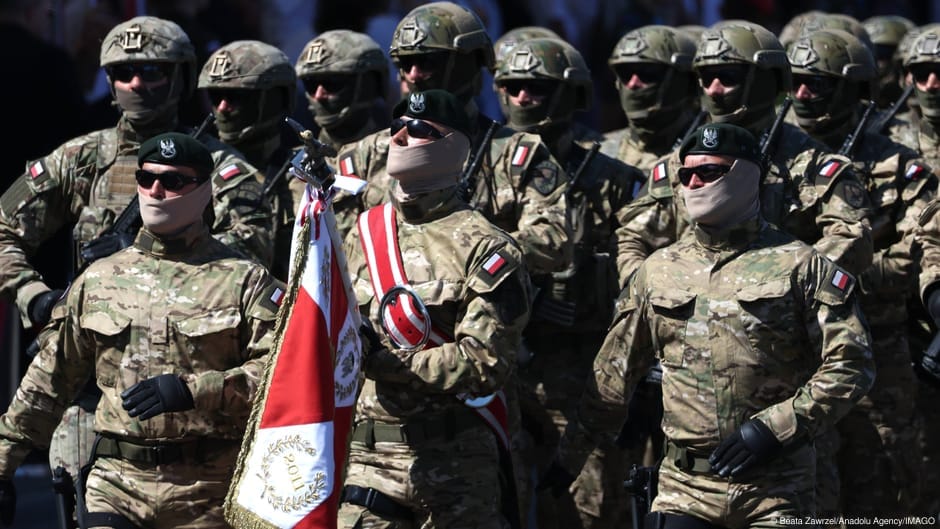
Poland plans to establish a no-fly zone along its eastern border by early 2027, a move intended to give its armed forces additional support in detecting and responding to incursions by Russian aircraft.
Deputy Defence Minister Cezary Tomczyk said on Wednesday, November 25, that the government was preparing a decision on the restrictions. He expressed hope that the measures would be introduced “closer to the end of December or the beginning of January,” putting implementation around the turn of 2027.
“It would be a restricted zone located some distance — from about 12 kilometres to several dozen kilometres — from the border,” Tomczyk said.
The measure would allow the Polish military to identify Russian aircraft entering national airspace more quickly and, if necessary, shoot them down. Warsaw also intends to encourage NATO allies to introduce comparable restrictions along their own eastern borders.
For Britain and the European Union, Poland’s proposal adds another layer to the security calculations surrounding NATO’s eastern flank. The UK is a major European member of the alliance, while Poland’s position on the EU’s external border makes its air-defence decisions relevant to broader European transport, trade and investment risk. Any expansion of restricted airspace would be watched by airlines, logistics companies and insurers assessing routes and exposure across Central and Eastern Europe.
Existing restrictions already limit border flights
Parts of the Polish border region are already subject to aviation controls. Flights are almost entirely prohibited during hours of darkness, while daytime operations must remain at an altitude of at least three kilometres.
The planned zone would formalise an additional military buffer extending from roughly 12 kilometres to several dozen kilometres from the frontier. The precise commercial implications will depend on the final boundaries, operating rules and whether neighbouring NATO states adopt similar measures. The source article did not report any immediate reaction in London equities, European shares or sterling following Tomczyk’s remarks.
Even without a reported market move, the proposal is relevant to London because geopolitical risk can influence European defence companies, airlines, energy markets and the pound. Investors typically distinguish between limited defensive measures and steps that could widen direct engagement with Russia. Poland’s proposed border zone falls within its own territory, but Warsaw is also discussing a more contentious option involving Russian missiles over Ukraine.
NATO allies consider missile interception proposal
Earlier the same day, Bloomberg reported, citing sources, that Poland had proposed that NATO allies shoot down over Ukraine any Russian missiles heading towards alliance territory. The idea was raised on November 23 at a meeting of NATO member-state ambassadors in Brussels.
Tomczyk said the proposal had not received unequivocal support, warning that such a decision would create “many complications.” Talks are continuing, according to Polish Defence Minister Wladyslaw Kosiniak-Kamysz, who told radio station RMF24 that he did not yet see sufficient “readiness and determination” among allies to take that step.
The distinction matters for Britain and other European NATO members. A restricted zone inside Polish territory would strengthen national airspace controls, while intercepting missiles over Ukraine could require a more extensive allied political and military commitment. The lack of unanimous backing indicates that governments remain cautious about measures that could increase the risk of escalation.
Russian missiles intensify pressure on Warsaw
Poland advanced the interception proposal after three Russian Kh-101 missiles fell in the country’s southeast on November 20. Prime Minister Donald Tusk described the incident that day as an apparent deliberate provocation.
“It appears that we are dealing with a deliberate provocation,” Tusk said.
He argued that the violations of Polish airspace clearly demonstrated why Warsaw should participate in negotiations over peace in Ukraine, which has been resisting the Russian military invasion for almost five years.
The incidents are likely to reinforce Polish demands for stronger protection of NATO airspace, even as allies debate how far collective measures should extend. For EU policymakers, the discussions connect border security with aviation management, defence spending and economic resilience. For the UK, they underline the importance of NATO coordination at a time when European security developments can affect business confidence and sterling-sensitive sentiment.
Attention will now turn to the Polish government’s final decision, the detailed dimensions of the restricted area and the response from other eastern NATO members. Markets in London and across Europe will also assess whether the measure remains a contained defensive adjustment or becomes part of a broader shift in the alliance’s approach to Russian missiles and aircraft near NATO territory.



