Polish President Joins Warsaw Nationalist March Drawing 250,000
The demonstration highlights political tensions in a key EU economy, though no immediate sterling or London market reaction was reported.
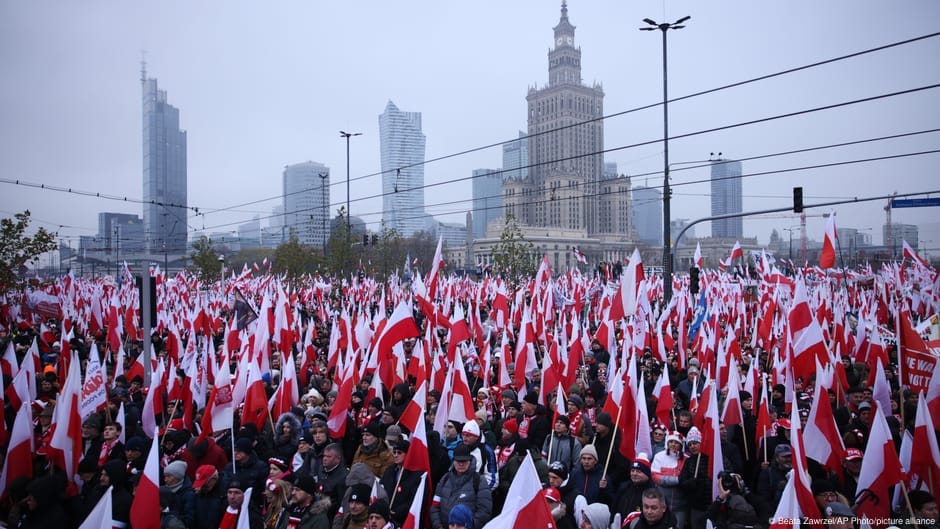
Polish President Karol Nawrocki joined a nationalist-led Independence Day march in Warsaw that drew about 250,000 people, according to the Polish capital’s authorities, placing the country’s political divisions back in focus for European governments and businesses.
Organisers put attendance at more than half a million. The demonstration, held on Wednesday, November 11, was initiated by nationalist and far-right groups to mark Poland’s National Independence Day. Far-right activists have organised similar annual events in the country since 2011.
For British and European companies, the gathering matters less as a single-day market event than as another indication of the political pressures affecting one of the European Union’s largest member states. Poland is an important destination for European investment and a major participant in regional manufacturing and supply chains. The source material reported no immediate move in sterling, Polish assets or London-listed companies linked to the march, and provided no evidence of a direct London market reaction.
Domestic power struggle adds to investor scrutiny
The march took place amid a confrontation between Prime Minister Donald Tusk’s government and Nawrocki’s political camp over control of Poland’s Constitutional Tribunal. That institutional dispute is likely to command attention in Brussels because questions surrounding the rule of law have previously shaped relations between Poland and EU institutions.
The demonstration also came only days after a shooting in central Krakow that killed six people. Security measures were strengthened for the Warsaw event.
Before the march began, Poland’s national anthem was played. Some participants carried torches whose thick smoke enveloped the crowd, while many wore red and white and waved national flags.
Near the Palace of Culture and Science, tents and stalls formed what was described as an “independence city”. Rosaries, prayer books, red-and-white wreaths, hot tea and sauerkraut were distributed there. Journalists also reported antisemitic and anti-Ukrainian books, alongside items bearing far-right symbols.
“Poland is not for sale” and “Remigration, deportation” were among the slogans displayed by participants.
Other demonstrators carried a banner reading “Make Europe white again”, echoing the structure of US President Donald Trump’s “Make America Great Again” slogan. The rhetoric underscored the march’s hard-line position on migration and identity at a time when immigration policy remains politically sensitive across both the EU and the UK.
Nawrocki and Tusk offer competing messages
Nawrocki was photographed carrying a Polish flag during the procession. He called for a “strong and capable state” and criticised “elites acting against the will of the people”. His participation gave presidential visibility to an event organised by supporters of far-right views and sharpened the contrast with Tusk’s more centrist, pro-European political camp.
Tusk declined to attend the demonstration. Instead, he called for national unity, saying: “On November 11, all hearts are white and red.”
The annual march is intended by its organisers to commemorate Poland’s restoration of independence on November 11, 1918, following 123 years of foreign rule by Russia, Prussia and Austria. Its scale has also made it an important platform for nationalist politics and a closely watched test of public order.
For the EU, the event combines several sensitive issues: migration, relations with Ukraine, antisemitism, institutional independence and the political direction of a strategically important eastern member state. Poland’s location and economic weight give developments in Warsaw significance beyond its domestic politics, particularly as European governments manage security and commercial ties across the region.
Britain also has substantial social and economic connections with Poland, including trade, investment and a large Polish community in the UK. Any sustained deterioration in Poland’s political stability or relations with Brussels could therefore be relevant to British businesses with Central European exposure.
However, the information available does not establish any immediate effect on sterling or London equities. Currency and stock-market investors would typically require a clearer policy consequence—such as changes to trade, public spending, EU relations or institutional governance—before translating a political demonstration into asset-price moves.
The immediate significance of the Warsaw march is therefore political rather than financial. Its unusually large reported attendance, the president’s participation and the openly extremist material observed around the event underline the strength and visibility of nationalist forces as Poland’s government and presidency compete for institutional authority.



