Slovak Protests Put Fico’s Kremlin Ties in Focus for UK and EU Investors
Thousands rallied in Bratislava over rule-of-law concerns, media controls and Robert Fico’s Russia links as his coalition lost its majority.
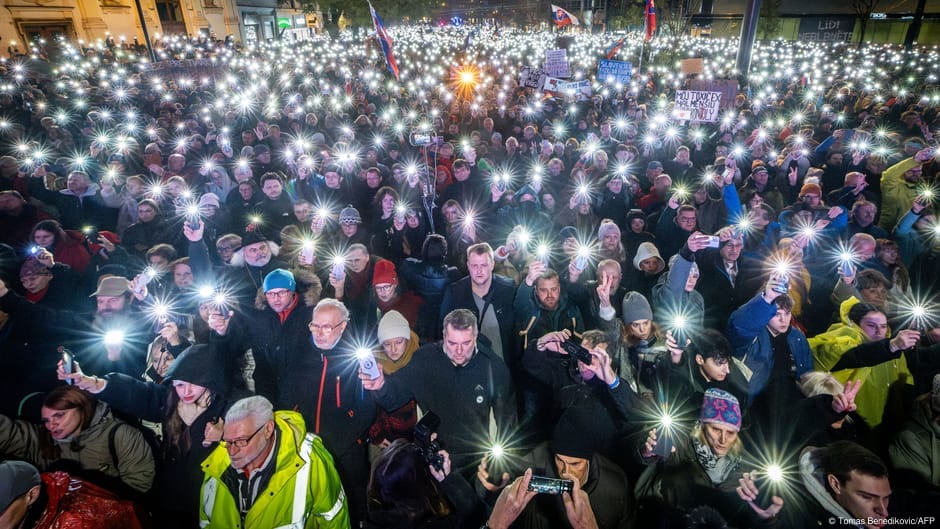
Thousands of people took to the streets in Slovakia on Monday, November 17, in protests against Prime Minister Robert Fico’s government, its connections with the Kremlin and policies aimed at controlling the media.
The demonstrations, held on the 37th anniversary of the start of the 1989 Velvet Revolution in Czechoslovakia, also reflected anger over alleged violations of LGBT rights and the rule of law. For businesses and investors in Britain and the European Union, the unrest highlights renewed political uncertainty inside the EU at a time when governments are seeking greater unity on security, Russia and democratic standards.
The largest rally was held in Slovak National Uprising Square in Bratislava. Progressive Slovakia, the country’s biggest opposition party and the organiser of the demonstration, estimated that about 25,000 people attended.
Protesters chanted “We have had enough of Fico!” and carried banners demanding the resignation of the three-party government led by the prime minister. Some placards read “Russians, go home!” and “I do not want a country I will have to flee.”
“We have had enough of Fico!” the crowd chanted as demonstrators called for the government to step down.
Political instability raises European business concerns
The protests carry significance beyond Slovakia’s domestic politics because the country is an EU member whose policy direction affects the bloc’s ability to maintain a common approach towards Moscow. Demonstrators specifically criticised Fico’s links with the Kremlin, while some told AFP they were unhappy with Slovak Foreign Minister Juraj Blanar’s recent visit to Moscow.
For UK and European companies, the immediate issue is not a specific policy change announced at the rallies but the broader risk created by a weakened government and demands for an early election. Political instability can complicate corporate planning, particularly when it intersects with questions about media independence, the rule of law and relations with Russia.
Those concerns are closely watched in London because British businesses operating across the EU depend on predictable regulation and consistent enforcement of legal standards. Slovakia’s political direction may also matter to companies with supply chains or commercial relationships in Central Europe, even though the source material provided no evidence of a direct reaction in London-listed shares or sterling following Monday’s demonstrations.
The absence of a reported immediate market move does not remove the political risk. Investors generally distinguish between a large public protest and an event capable of changing government policy. In this case, attention is likely to remain on whether the demonstrations increase pressure on Fico’s administration, weaken its ability to pass legislation or accelerate calls for a national vote.
Coalition loses its absolute majority
Fico’s ruling coalition recently lost its absolute majority in parliament after several lawmakers left the governing alliance, according to AFP. The development has encouraged the opposition to demand an early parliamentary election.
However, opposition parties do not currently have the votes required to approve such a move. That leaves Slovakia facing a period in which the government is under visible public pressure but its opponents lack the parliamentary strength needed to force an election.
This institutional deadlock is important for the wider European business community. A government without an absolute majority may find it harder to deliver a stable legislative programme, while continuing disputes over democratic governance can intensify scrutiny from EU partners. The protests themselves did not set out new economic measures, and no direct effect on sterling was reported, but prolonged uncertainty could influence how international companies assess political and regulatory risk in Slovakia.
For the EU, the demonstrations also underline the challenge of balancing national political choices with shared commitments on the rule of law. The protesters’ focus on alleged media controls, LGBT rights and Kremlin ties brings several politically sensitive issues together in a single movement.
Britain is outside the EU, but developments within the bloc remain relevant to UK trade, investment and European security. London investors will therefore be watching whether Fico can stabilise his three-party coalition and whether the opposition can convert large street protests into sufficient parliamentary support for an early election.
The anniversary chosen for the rallies added historical weight to the opposition’s message. The Velvet Revolution began in 1989 and ended communist rule in Czechoslovakia. By gathering on its 37th anniversary, demonstrators linked their current objections to concerns about democratic institutions and Slovakia’s political orientation.
For now, Fico remains in office, the opposition remains short of the votes needed to trigger an early election, and the protests have sharpened scrutiny of Slovakia’s relationship with Moscow. The next test for markets and European partners will be whether public pressure produces a concrete change in parliamentary arithmetic or government policy.



