Ukraine Confirms 72 Dead After Russian Strike on Humanitarian Centre
The attack intensifies scrutiny of European support for Ukraine as Britain and the EU assess security and humanitarian commitments.
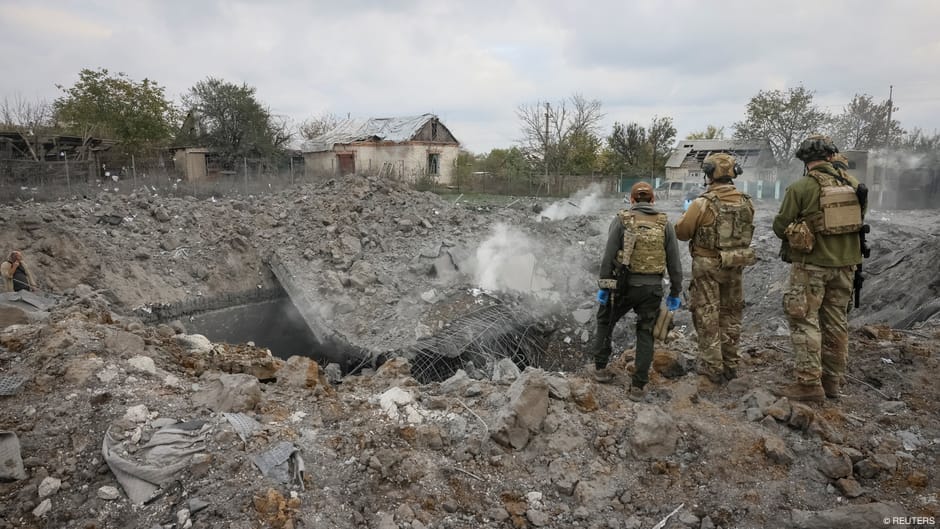
Ukrainian rescue crews have completed a two-week operation at a humanitarian aid centre in Kamyshevakha, in the Zaporizhzhia region, confirming that 72 people were killed by a Russian air strike. Four others remained missing when search operations and the removal of rubble ended on Monday, 16 November.
The scale of the loss places the 2 November strike among the deadliest Russian attacks on civilians at a single location since the beginning of the full-scale war. It also adds pressure on Britain and the European Union to maintain humanitarian assistance and security support for Ukraine as the conflict continues to generate substantial economic, fiscal and geopolitical risks across Europe.
Rescuers recovered 58 bodies from the wreckage of the building hit by an aerial bomb. One person later died in hospital, while the deaths of another 13 people were established through DNA analysis. Two rescuers and four police officers were among those killed.
Four injured people remain in hospital, according to Ukrainian Interior Minister Ivan Vyhovskyi. The Zaporizhzhia regional military administration said four people were still classified as missing.
Humanitarian distribution under attack
Russian forces dropped aerial bombs on the morning of 2 November on a disused school building in Kamyshevakha where humanitarian assistance was being distributed, Ukrainian Prime Minister Serhiy Koretskyi said. According to his account, Russian forces also struck the shelter after people had moved into it, using nine aerial bombs in the operation.
The attack occurred while aid was being handed out, contributing to the high number of casualties. Information about the humanitarian event had been announced officially in advance.
Search-and-rescue work continued for two weeks under dangerous conditions. During that period, local authorities said Kamyshevakha was subjected to another 11 Russian attacks, nine of which directly hit the site where crews were clearing debris. Three police officers and four rescuers were injured in the repeated strikes.
The continuing danger faced by emergency workers highlights the practical challenges confronting European-backed relief operations in Ukraine. Britain and EU member states are important providers of humanitarian, financial and military assistance, and attacks on known distribution points complicate the delivery of aid while increasing the resources required to protect workers and reach civilians near the front line.
Implications for Britain and Europe
For British and European businesses, the strike reinforces the persistence of the geopolitical risk surrounding the war. The direct consequences are humanitarian, but the conflict also remains relevant to public spending, energy security, insurance, transport and investor confidence across the region. Any assessment of sterling or London-listed assets, however, must distinguish those broader pressures from a specific market reaction: Ukrainian officials and the source account did not report a direct move in the pound or in London markets linked to the Kamyshevakha attack.
The deaths are nevertheless likely to sharpen debate in London and European capitals over the durability of assistance to Kyiv. Support packages affect government budgets and procurement plans, while the security outlook influences companies with exposure to defence, energy, logistics and reconstruction. The destruction of a humanitarian centre also underscores the operational hazards facing organisations and contractors working in Ukraine.
Based on the number of civilians killed at one site, the Kamyshevakha bombing was one of Russia’s deadliest attacks since the full-scale invasion began. Some media organisations have compared it with Russia’s bombing of the Mariupol theatre in March 2022, although there is no confirmed figure for the number killed in that attack.
UN raises international law concerns
Russia has not commented on the attack on the Kamyshevakha humanitarian centre. The actions of the Russian military were condemned at the United Nations, where the head of the UN Human Rights Monitoring Mission in Ukraine, Danielle Bell, questioned whether Russian forces had taken even basic precautions before the strike.
“Either the Russian armed forces knew that humanitarian aid was being distributed there, or they failed to take the most basic steps to determine what was happening in the settlement they intended to attack. In either case, this strike appears to have violated the most fundamental principles of international humanitarian law,” Bell said.
The UN assessment places renewed attention on the legal obligations governing attacks in populated areas and the protection of civilians and humanitarian activity. For the UK and EU, both prominent diplomatic supporters of Ukraine, the findings are relevant to discussions about sanctions, accountability and the continued financing of relief programmes.
With four people still missing and four casualties remaining in hospital, the final human toll may not yet be fully settled. The completion of the rubble clearance closes the immediate rescue phase, but the repeated attacks during the operation demonstrate that emergency response and humanitarian delivery remain exposed to continuing military action.



