Zelensky Says Crimea Bridge Will Not Survive as Ukraine Plans Response
Damage to the strategic crossing raises logistical and infrastructure risks with wider implications for European security and trade.
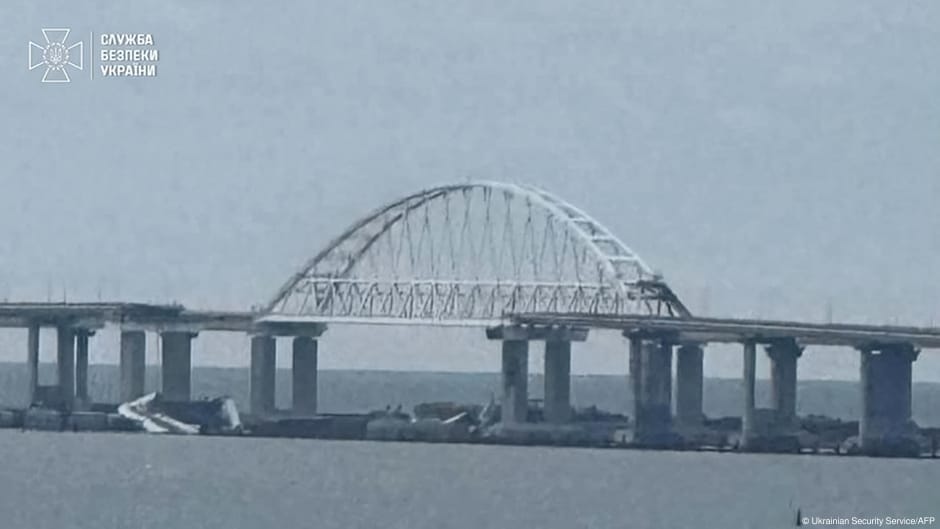
Ukrainian President Volodymyr Zelensky has said the Crimean Bridge will not remain standing, describing the Russian-built crossing as a legitimate military target and indicating that Ukrainian attacks on it could continue.
Speaking in an NBC News interview on Friday evening, November 20, Zelensky was asked about the future of the bridge across the Kerch Strait, which connects Russia with Crimea. Moscow annexed the Ukrainian peninsula after Russian forces occupied it in the spring of 2014, a move that has not received international recognition.
“Putin must understand that this bridge will not survive,” Zelensky said.
The warning places renewed attention on a piece of infrastructure central to Russia’s military logistics in Crimea. For Britain and the European Union, further disruption would be viewed primarily through the conflict’s effects on regional security, transport networks and the wider European economic outlook. The source article provided no specific evidence of a reaction in London markets or a direct move in sterling following Zelensky’s remarks.
Bridge damage threatens a key Russian supply route
Zelensky argued that Ukrainian operations against the structure are lawful because Crimea remains occupied Ukrainian territory. He said Russia had seized the peninsula as its first target in 2014, subsequently built the bridge and declared it part of Russia.
He also recalled that Moscow had changed its constitution and domestic legislation after the occupation in an attempt to incorporate Ukrainian territories. Those measures, Zelensky said, had not been supported internationally and possessed no international recognition.
The Ukrainian president suggested that further strikes could follow, saying Russia should experience the consequences of war and recognise that it cannot retain control of the peninsula. He linked Ukraine’s attack on the bridge to Russian strikes on Ukrainian facilities.
“They attacked several of our facilities, and of course we had to respond. And of course we responded with a strike on the Crimean Bridge,” Zelensky said.
He added that Ukraine would not accept the occupation of its territory, whether the issue was ultimately resolved through diplomacy or military action.
According to Zelensky, Russia continues to use the bridge to move as many weapons as possible into Crimea. Daily reports from Ukraine’s armed forces say missile and unmanned aerial vehicle launches frequently originate from the annexed peninsula.
Repair timetable remains uncertain
The occupation authorities in Crimea reported a strike on the bridge on the morning of November 16, after which road traffic across the crossing was restricted. A day later, reports said that one of the bridge’s arches and part of its roadway had collapsed into the sea following a repeat strike.
The railway section was targeted during the night of November 19 and is now badly damaged, according to the source account. Russian Deputy Prime Minister Marat Khusnullin said on November 20 that Ukrainian attacks had damaged the main beam of the arch span as well as the arch itself.
Khusnullin said possible restoration dates were unknown and could be determined only after engineering design decisions had been issued. Russian authorities had announced a resumption of train services over the bridge a day earlier, following the Ukrainian attacks.
He had previously said that officials expected to assess the restoration schedule within a week. Some individual elements might be put back into service within one or two months, he said, while the remaining work would depend on further examination. Khusnullin also noted that storm season complicated the assessment.
Andrii Koretskyi, an associate professor in the bridges, tunnels and hydraulic structures department at Kyiv’s National Transport University, offered a significantly longer estimate. He assessed the potential restoration period at between one and a half and three years.
Koretskyi said manufacturing an arch alone would take about a year, before assembly at the site, transportation and installation. He added that he did not believe Russia would be allowed to install such an arch again without disruption near Ukraine’s border.
European investors face another source of geopolitical risk
The scale and timing of any future attack remain unspecified, while the available repair estimates vary sharply. That uncertainty matters to European businesses because the bridge combines military, transport and political significance in a conflict already affecting public finances, defence planning and commercial confidence across the region.
For UK and EU decision-makers, Zelensky’s comments reinforce the prospect of a prolonged contest over Crimea and the infrastructure supporting Russia’s presence there. For investors in London, the immediate significance lies in the possibility of renewed escalation rather than in any market movement documented by the source. No sterling price change, equity-market response or direct impact on British companies was reported.
The bridge’s condition will therefore remain a closely watched indicator of Russia’s ability to supply Crimea and of Ukraine’s capacity to strike strategic infrastructure. Zelensky’s message was that Kyiv considers the crossing part of the military architecture sustaining the occupation—and that it does not regard the bridge’s continued operation as permanent.



