Italy Cost-of-Living Protests Raise Fresh Concerns for European Business
Security was tightened across major Italian cities as protests over prices, fuel costs and government policy continued on Saturday.
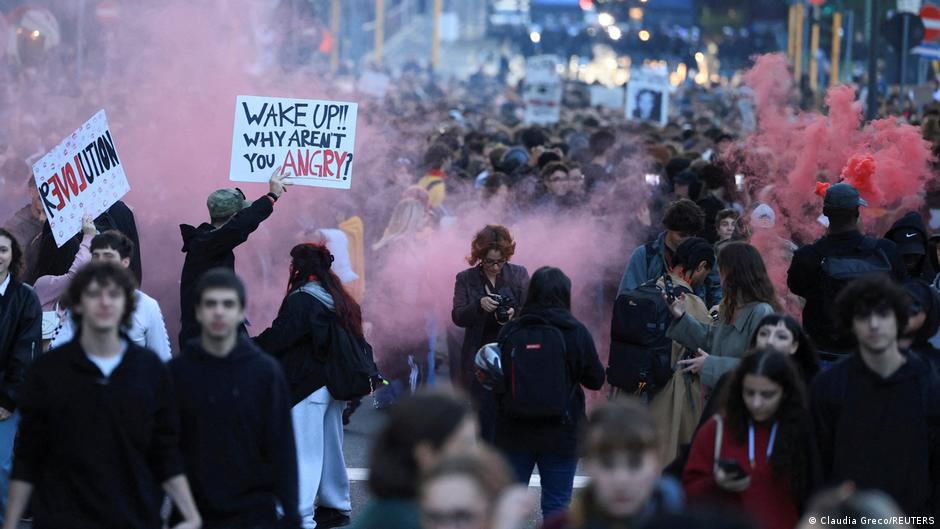
Italy faced renewed demonstrations on Saturday, October 24, as protesters took to the streets over the high cost of living, rising fuel prices, increased military spending and the policies of Prime Minister Giorgia Meloni’s government.
The latest unrest is being closely watched beyond Italy because of the country’s importance to the European Union and its deep commercial links with Britain. For companies operating across Europe, prolonged disruption in major Italian cities could affect retail activity, transport and business confidence at a time when households remain sensitive to everyday costs. London investors will also be alert to any broader implications for European political stability, although the information available did not specify a direct reaction in UK equities, bond markets or sterling.
Italian police reported nine arrests and 371 cases of preliminary detention, including 110 involving minors, according to AFP. The figures followed protests on October 17 and 18 that descended into disorder and prompted the authorities to reinforce security.
Security tightened in Milan and other commercial centres
The Italian authorities deployed 500 members of elite military units to Milan after the earlier disturbances. The government also simplified procedures for detaining minors and for imposing financial penalties on their parents when property is damaged.
Drones and helicopters were used to monitor Saturday’s demonstrations, while patrols were strengthened at railway stations. Authorities also closely tracked online activity in an effort to identify fresh calls for disorder.
Police reported nine arrests and 371 preliminary detentions, with 110 of those cases involving minors.
In Milan, Italy’s principal financial and fashion centre, the protests remained largely peaceful until the evening, according to the German news agency dpa. Demonstrators later clashed with law enforcement officers in the city centre. Police stopped a column of protesters and used batons.
Fearing further disorder, the owners of many luxury shops barricaded their display windows. That precaution placed the economic impact of the demonstrations in clear view: Milan is a major destination for international shoppers and an important centre for European luxury brands. Even where protests remain peaceful, restricted access and concerns over property damage can weigh on trading conditions for retailers and other city-centre businesses.
For British companies and investors with exposure to Italy’s consumer, tourism, fashion and transport sectors, the immediate concern is whether the demonstrations remain episodic or become a more persistent source of disruption. The protests also underline the political pressure created by high household expenses and fuel prices, issues that affect consumer demand across both the EU and the UK.
Police intervene in Bologna and Turin
In Bologna, police used tear gas and water cannon to prevent a column of demonstrators from approaching the railway station. In Turin, law enforcement officers used shields to push protesters back.
Railway stations are especially sensitive locations for businesses because interruptions can quickly affect commuters, domestic travel and freight connections. The heightened patrols and the intervention in Bologna indicated that authorities were seeking to keep the protests away from important transport infrastructure after the disorder recorded the previous weekend.
Rome also saw a demonstration through its historic centre that was predominantly pro-Palestinian. At one point, participants entered the Colosseum, dpa reported. Demonstrations were additionally held in Naples and Florence, showing that the mobilisation extended across several of Italy’s most prominent urban, commercial and tourist destinations.
European political risk comes into focus
The demonstrations bring together several sources of dissatisfaction, including living costs, fuel prices, military expansion and opposition to Meloni’s government. That combination matters for European businesses because it connects pressure on household finances with wider disputes over public spending and national policy.
For London markets, the events are primarily a political-risk signal rather than evidence of a specific financial shock. Investors commonly assess unrest for its potential effect on consumer spending, tourism, supply chains and government policy. The source material, however, provided no figures for market movements and no evidence of a direct change in sterling linked to Saturday’s demonstrations.
Any currency consequences would therefore depend on whether the unrest begins to influence broader confidence in the European economy or expectations for Italian and EU policy. Sterling’s response would also reflect UK-specific conditions and the relative outlook for the pound and euro, rather than events in Italy alone.
The immediate focus remains on public order and the authorities’ effort to prevent a repeat of the previous weekend’s disorder. With extensive surveillance, reinforced station patrols and hundreds of preliminary detentions, Italy has adopted a visibly tougher security posture while protests continue across the country.