Venice Biennale Protest Highlights Political Tensions at Russian Pavilion Amid EU Sanctions
Activists demand representation of Russian political prisoners at Venice Biennale, prompting London market and EU scrutiny over Russia’s cultural presence.
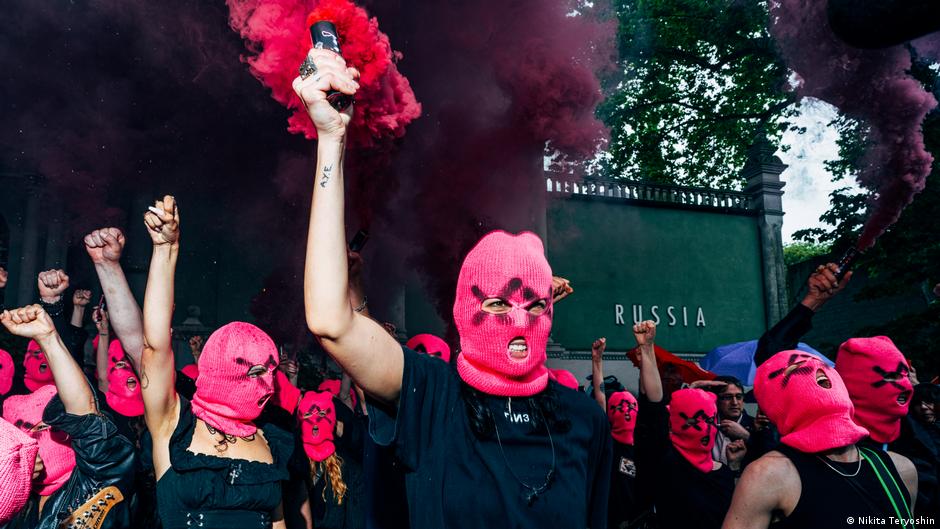
On May 6, feminist punk group Pussy Riot and Ukrainian activist collective Femen staged a protest at the Russian pavilion during the Venice Biennale, calling for Russia's artistic representation to be led by political prisoners who oppose the Kremlin and support Ukraine.
Protest Highlights Clash Between Art and Politics
The demonstrators ignited pink, yellow, and blue smoke flares—the colors of the Ukrainian flag—and chanted slogans such as "Russian art is blood" outside the pavilion. They held placards reading "Enjoy the show—ignore the war," "Curated by Putin, corpses included," and "Art on display, graves below." Several protesters painted these messages on their bodies, while Ukrainian flags and masks were hung on statues around the pavilion.
“The best citizens of Russia are either imprisoned for anti-regime and pro-Ukrainian actions or killed in dungeons, while Europe opens its doors to Putin’s officials and propagandists,” said Pussy Riot member Nadezhda Tolokonnikova.
Tolokonnikova called on Venice Biennale organizers to allow artists imprisoned for their anti-war and pro-Ukrainian positions to represent Russia, challenging the legitimacy of the current pavilion’s content.
Femen leader Inna Shevchenko condemned the pavilion’s art as metaphorically constructed on "invisible pedestals of Ukrainian blood," a reality omitted from official catalogs but essential to understanding the exhibit’s context.
European Union and London Market Response
Russia’s participation in this year’s Venice Biennale marks its first since the full-scale invasion of Ukraine began in February 2022. The EU and Ukraine sharply criticized the decision to allow Russia’s pavilion, citing breaches of EU sanctions legislation. The European Commission considers the pavilion's presence an infringement due to the ongoing conflict and associated sanctions.
Organizers limited access to the pavilion, opening it only from May 6 to 8 for invited guests during continuous sound performances, and closing it to the public from May 9 onward. In response to criticism over the Russian and Israeli pavilions, the Biennale jury excluded both countries from award consideration and subsequently resigned.
London’s financial markets and cultural institutions have been watching these developments closely, given the implications for sterling and European economic relations with Russia. The controversy underscores the delicate balance the UK and EU face between cultural engagement and political accountability amid ongoing geopolitical tensions.
Links to Russian Elite Raise Questions
The Russian pavilion is managed by Smart Art, a company founded by Ekaterina Vinokurova and Anastasia Karneeva. Karneeva is the daughter of a retired general and former deputy director of the state defense conglomerate Rostec, while Vinokurova is the daughter of Russia’s Foreign Minister Sergey Lavrov. These connections have fueled additional scrutiny regarding the pavilion’s role in projecting sanctioned Russian state narratives within European cultural spaces.