Georgia Detains Ex-Defence Minister Baramidze in Treason Case
The case against a Saakashvili ally adds a fresh political risk point for UK and EU observers tracking Georgia’s stability.

Georgia has detained Giorgi Baramidze, a former acting prime minister and ex-minister of defence and internal affairs, on accusations of “treason, namely sabotage”, after remarks he made about the 1992-1993 war in Abkhazia. The case is likely to draw close attention in London and Brussels, where Georgia’s political direction, institutional reliability and security alignment remain important considerations for investors, diplomats and policymakers.
Baramidze, 58, is one of the leaders of the United National Movement, the party associated with former Georgian president Mikheil Saakashvili. Georgia’s deputy prosecutor general, Amiran Guluashvili, said Baramidze would be charged with “treason against the homeland, namely sabotage”. The decision, prosecutors said, was taken “on the basis of a court ruling”. A press release was published on the website of Georgia’s Prosecutor General’s Office on Friday, 11 September.
The arrest comes at a sensitive moment for European business interests in the wider Black Sea and Caucasus region. Georgia is not a major direct driver of sterling trading, but political instability in a strategically placed state between Europe and Asia can still matter for London-listed emerging market funds, regional infrastructure investors and companies exposed to transport, logistics, energy transit and frontier-market risk. For UK investors, the immediate market effect is likely to be indirect: a rise in perceived political risk rather than a direct sterling shock.
Remarks on Abkhazia Triggered the Case
The case stems from comments Baramidze made during an appearance on “The Birth of Georgia”, a programme broadcast on 18 July on the YouTube channel of the same name run by Iago Khvichia, leader of the opposition libertarian party New Political Centre - Girchi. According to prosecutors, Baramidze said that at the start of the 1992-1993 war in Abkhazia, Georgian soldiers did not take prisoners but shot them on the spot, and that, as a result, the Georgian side unlike the Abkhaz side had no pool of prisoners available for exchanges.
Law enforcement authorities opened an investigation into Baramidze’s statement on 7 August after a complaint from the state service for veterans’ affairs. The Prosecutor General’s Office later said it had not found facts confirming that prisoners had been shot by the Georgian army. Prosecutors described Baramidze’s statement as “baseless and fabricated”, and said it had an intentional ideological and propaganda character.
Prosecutors said the remarks contributed to undermining Georgia’s state and national interests, external security, defence capability and state institutions.
The Prosecutor General’s Office also said Baramidze’s comments damaged Georgia’s image, harmed the reputation of the country’s Defence Forces, and offended the honour and dignity of veterans of the war in Abkhazia and fallen servicemen. Officials further argued that the statement threatened the process of reconciliation and confidence-building among people affected by the conflict, undermined Georgia’s policy on peace and de-occupation, and complicated the normal work of state agencies.
Prosecutors now intend to ask a court to place Baramidze in pre-trial detention. Law enforcement authorities said the investigation was continuing and that the public would be informed about its progress and results.
European Risk Lens
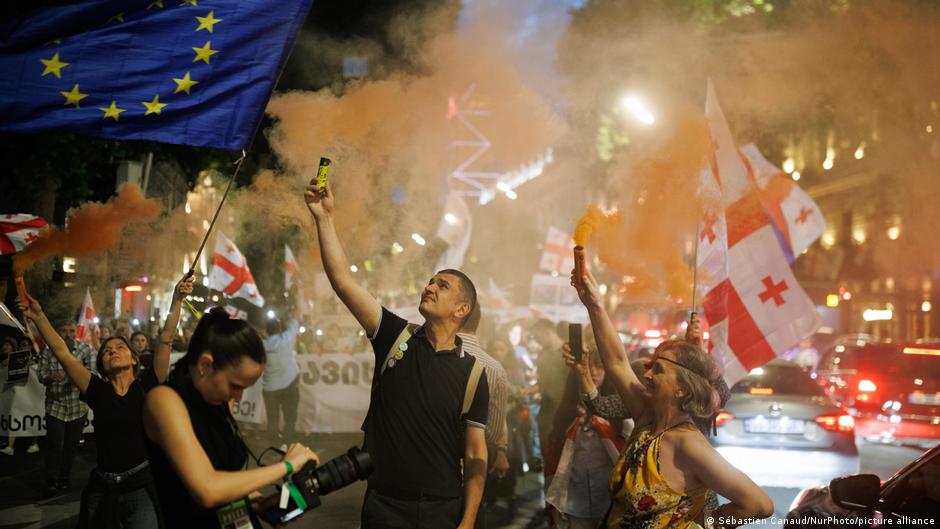
For the UK and the European Union, the case sits within a broader assessment of Georgia’s political environment. The country has long occupied a strategic position for European policymakers because of its location on transit routes linking the Black Sea, Turkey, the South Caucasus and Central Asia. Political prosecutions, especially involving former defence chiefs and opposition figures, can raise questions about institutional independence and the predictability of governance.
Daily Edge readers watching European markets should see the development as part of a wider political-risk picture rather than as a standalone currency event. Sterling is more directly shaped by UK inflation, Bank of England expectations, fiscal policy and global risk sentiment. Still, when political tensions rise in countries tied to European security and trade corridors, investors often reassess exposure to regional assets. That reassessment can feed into risk pricing for funds, banks or companies with broader emerging Europe mandates.
The Baramidze case also lands against the backdrop of several criminal proceedings involving former Georgian defence ministers. Baramidze is the fifth former defence minister in Georgia to face a criminal case. In July, Bacho Akhalaia, another Saakashvili ally, was sentenced to two and a half years in prison after being found guilty of public calls to overthrow the government following his remarks at a court hearing.
In November 2025, former interior and defence minister Irakli Okruashvili was sentenced to seven years in prison in connection with the high-profile killing of 19-year-old Amiran Robakidze during a police inspection in 2003. Okruashvili had supported Mikheil Saakashvili until 2007.
Former members of the government of the ruling Georgian Dream party are also in custody. Juansher Burchuladze, who headed the defence ministry until February 2024, and Irakli Garibashvili are both detained. Garibashvili served as defence minister from 2019 to 2021, prime minister from 2021 to 2024, and chairman of Georgian Dream from 2024 until April 2025. Burchuladze is accused, among other things, of taking bribes, while Garibashvili is accused of money laundering.
For Brussels, the cumulative picture is politically significant. For London, the investment question is narrower but still material: whether Georgia continues to offer a stable operating environment for businesses and capital linked to European trade, infrastructure and security interests. The detention of a senior opposition-linked former minister on a treason-related allegation will therefore be watched not only as a domestic legal case, but as another test of Georgia’s institutional trajectory.