Khodorkovsky Urges Europe to Offer Russian Elites a Path Away From Putin
The opposition figure says European policy should encourage Kremlin divisions while avoiding measures that could trigger conflict inside Russia.
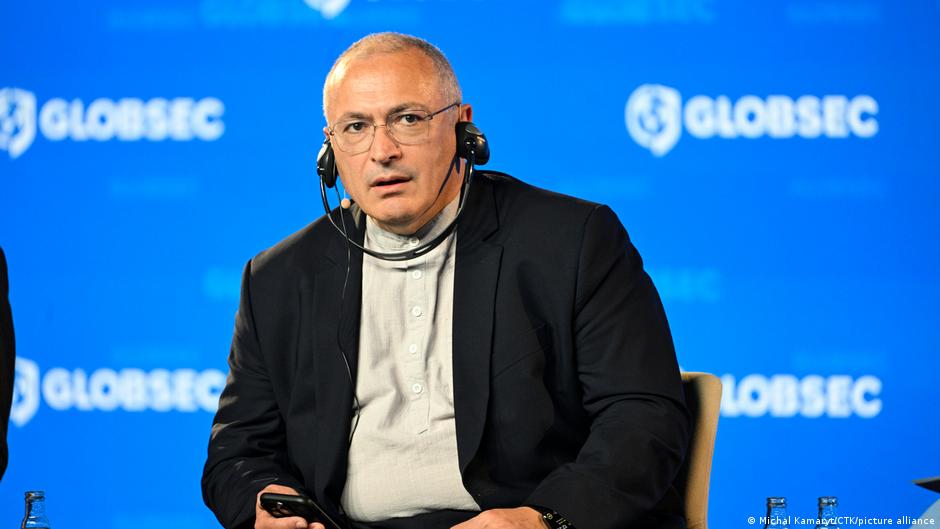
BRUSSELS — European governments should offer influential members of Russia’s elite a credible alternative to supporting President Vladimir Putin, opposition figure Mikhail Khodorkovsky said, arguing that the absence of a personal route out has made a split within the Kremlin’s orbit less likely.
Speaking at a conference of the Russian Anti-War Committee in Brussels on Tuesday, Nov. 3, Khodorkovsky said powerful Russians continued to stand behind Putin partly because they were not convinced that their position would improve without him. He also pointed to the extensive personal security system constructed by the Russian president when asked whether domestic actors could remove Putin.
“If we are talking about a split among the elites, then we need to show the possibilities for a personal exit,” Khodorkovsky said.
Such an exit could still involve losses for those concerned, he added. Khodorkovsky described Europe’s failure to create options of this kind by the fifth year of the war as a serious mistake, although he did not specify at the conference what conditions should apply.
He has previously argued that a declaration of disagreement would not be sufficient for people who had cooperated with the Russian regime. He cited donations to Ukraine and testimony to investigators about crimes committed by the regime as examples of actions that could demonstrate meaningful cooperation.
European Policy and Business Risk
The proposal carries particular relevance for Britain and the European Union, which have used sanctions, asset freezes and restrictions on Russian interests as central elements of their response to the war against Ukraine. Khodorkovsky’s argument suggests that European policy must balance continued pressure with incentives capable of changing the calculations of influential Russians.
For the UK and EU business communities, the wider issue is the risk attached to Russia’s eventual political transition. Companies, banks and investors across Europe have spent years managing exposure to sanctions, disrupted trade and geopolitical uncertainty. A disorderly transfer of power or armed confrontation inside Russia could deepen those risks, while a gradual reduction in tensions could eventually alter the outlook for European security and commerce.
The remarks did not include any assessment of sterling or a direct account of the London market’s response. However, the scenarios discussed in Brussels concern factors closely watched in London, including European security, sanctions policy, energy disruption and nuclear risk. Khodorkovsky’s emphasis was on reducing the probability of renewed conflict through political institutions rather than forcing a rapid transformation.
Warning Against Lustration and Internal Conflict
In his opening address, Khodorkovsky warned that attempts to prosecute people connected to the war or restrict their rights could provoke armed resistance within Russia. Millions of Russians, he said, were linked to the conflict because they or their relatives had fought, worked at military enterprises or supported the political order established by the authorities.
Some of those people were accustomed to handling weapons and could be prepared to resist measures directed against them, he said. “And we must understand that when we speak about lustration, reparations and trials of war criminals, we are speaking about a new war,” Khodorkovsky told the conference.
He contrasted an attempt to impose desired reforms by force with national reconciliation and gradual democratisation. In his assessment, an armed confrontation within Russia would produce another authoritarian system and postpone the prospect of democratic change for a further political generation.
Khodorkovsky issued a similar warning about the possible break-up of the Russian Federation. Such an outcome would be paid for in blood, he said, urging policymakers to discuss not only the result they wanted but also the means used to achieve it.
Institutional De-escalation
Instead, Khodorkovsky called for what he termed “institutional de-escalation”: reducing the threat of war by changing the structure of political power in Russia. Even a move from one-person rule to collective leadership could lower the likelihood of war, he argued.
A parliamentary model and greater federalisation would reduce that risk further, according to Khodorkovsky. His approach places institutional design at the centre of any post-Putin transition and cautions European policymakers against assuming that punishment, territorial fragmentation or an abrupt purge of the existing system would necessarily produce a stable democracy.
The two-day Russian Anti-War Committee conference is being held in Brussels on Nov. 3-4 and is focused on possible scenarios for ending Russia’s war against Ukraine. Its programme also includes discussions of sanctions, nuclear dangers and the possibility of putting Putin on trial.
For Britain and the EU, the debate highlights a difficult policy choice: how to maintain pressure over the war while creating incentives for figures inside the Russian system to change course. Khodorkovsky’s central contention is that political change will remain harder while those figures see no viable future outside Putin’s rule.