EU to Fund Ukrainian Drones and Missiles as Markets Watch Defence Push
Brussels says Ukraine will dominate this week’s European Council agenda as investors assess defence spending, energy risks and sterling exposure.
The European Union is preparing to provide Kyiv with additional funding in mid-October for the purchase of drones and missiles, placing Ukraine’s defence needs back at the centre of the European political and financial agenda.
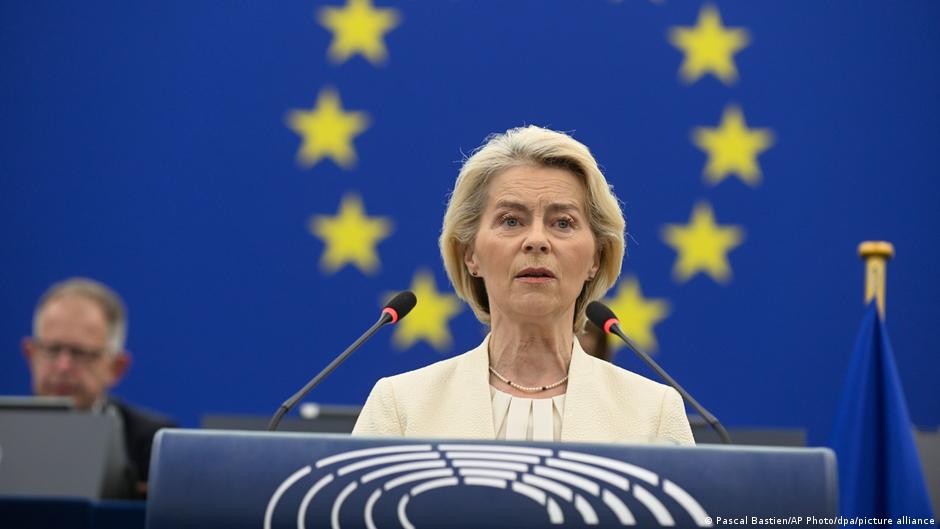
European Commission President Ursula von der Leyen announced the planned support on Sunday, 11 October, after holding a telephone call with Ukrainian President Volodymyr Zelensky. She said the funding was needed to strengthen Ukraine’s defence and protect its airspace, but did not specify the amount of financing or identify its sources.
For British and European businesses, the move reinforces a familiar but still significant market theme: the war in Ukraine remains a core driver of public spending priorities, defence procurement, energy risk and investor sentiment across the region. While the UK is no longer an EU member, London markets continue to price geopolitical risk through sterling, energy-linked equities, defence contractors and broader European exposure.
Von der Leyen said the support was necessary to strengthen Ukraine’s defence and protect its airspace.
Brussels has underlined that the situation in Ukraine will be one of the central issues discussed at this week’s European Council meeting. The talks are expected to cover Ukraine’s financing needs for the coming year and ways to mobilise new international support. According to von der Leyen, two new clusters of topics will also be unlocked as part of Ukraine’s negotiations with the EU.
Defence Spending Returns to the Market Agenda
The planned drone and missile funding comes at a time when European governments are under sustained pressure to raise defence capacity while maintaining fiscal discipline. For investors in London and across the continent, that creates a complex mix of opportunities and risks. Defence manufacturers and aerospace suppliers may benefit from continuing procurement demand, while governments face pressure to fund security commitments alongside domestic spending priorities.
The announcement also comes shortly after the European Commission approved a 2.9 billion euro tranche for Kyiv on 2 October under the Ukraine Facility, the EU mechanism designed to provide long-term financial assistance to Ukraine. That facility covers the period from 2024 to 2027 and is intended to allow the EU to provide Ukraine with up to 50 billion euros in stable and predictable financial assistance.
Those figures matter for European capital markets because they help define the scale and durability of the bloc’s support package. Predictable financial aid can reduce near-term uncertainty for Ukraine’s public finances, while also clarifying the fiscal burden carried by EU institutions and member states. For UK investors, the implications are indirect but material, especially through banks, insurers, infrastructure funds and multinationals with exposure to continental Europe.
Sterling may also remain sensitive to the broader geopolitical backdrop. Although the new EU funding is not a UK budget item, currency traders often assess the pound against a wider European risk environment. Heightened concerns over energy infrastructure, food supplies or further escalation can affect expectations for inflation, growth and central bank policy across the region, including in Britain.
Energy and Food Security in Focus
Von der Leyen said she fully supported Zelensky’s call for a ceasefire that would help protect global food supplies and energy infrastructure in Ukraine and Russia. That framing is likely to resonate with businesses still managing the aftershocks of the energy price shock that followed Russia’s full-scale invasion of Ukraine.
For UK companies, energy security remains a boardroom issue even after wholesale prices eased from earlier peaks. Manufacturers, logistics firms, food producers and retailers continue to monitor supply risks closely, particularly during the colder months. Any renewed pressure on energy infrastructure could revive concerns over input costs, margins and household spending.
The reference to global food supplies is also commercially significant. Ukraine remains a major agricultural producer, and disruption to exports can affect commodity markets, food manufacturers and supermarkets well beyond Eastern Europe. Businesses in Britain and the EU have spent recent years adapting to volatile grain, fertiliser and transport costs, and policymakers remain alert to the possibility that renewed disruption could feed into consumer prices.
Von der Leyen said the war had entered a new and even darker phase. She accused Russia of waging a prolonged war on the battlefield and striking civilians far beyond the front line. That assessment adds urgency to the EU’s decision to finance air defence-related capabilities, including drones and missiles, even as member states debate how to sustain support over another year.
The Ukraine Facility payments are closely tied to Kyiv’s implementation of a specific recovery and reform plan, as well as support for democratic mechanisms, the rule of law and human rights, according to the European Commission. Payments are made quarterly after checks on whether the conditions for support have been met.
That conditional structure is important for European policymakers seeking to reassure taxpayers and investors that long-term assistance is linked to institutional reforms. It also gives businesses a clearer framework for assessing Ukraine’s future reconstruction prospects, including opportunities in infrastructure, energy, technology and logistics once conditions allow.
In London, the immediate market reaction will depend less on the political announcement itself than on the details that follow: the size of the drone and missile funding package, its source, and whether the European Council signals a broader financing plan for the year ahead. Until those details are confirmed, investors are likely to treat the announcement as another indication that European defence and Ukraine support will remain durable themes for the region’s markets.