German Call for Defence Industry Role Puts Ukraine Aid Under Market Scrutiny
Johann Wadephul said German manufacturers should benefit from Berlin’s support for Kyiv, a message with implications for European defence spending.
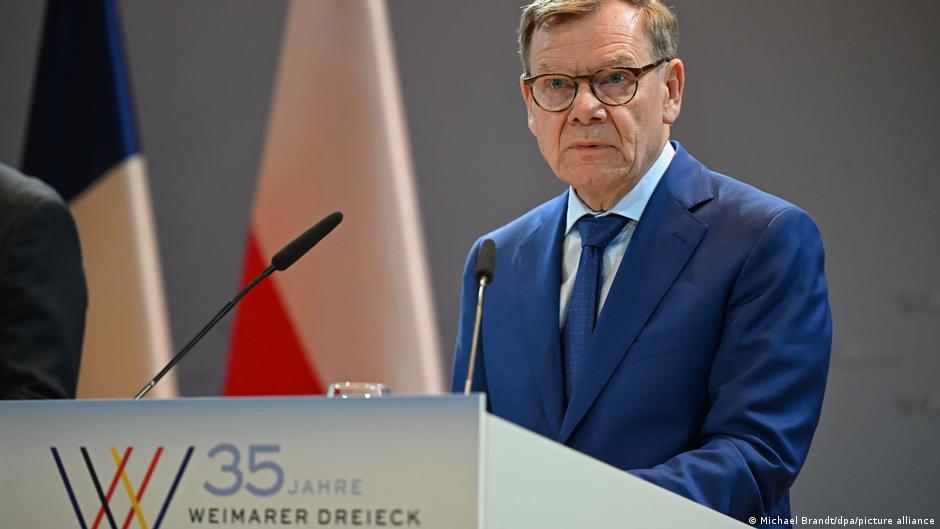
Germany’s foreign minister has urged Kyiv to pay closer attention to Berlin’s interests, saying German defence companies should benefit from Germany’s financial and military support for Ukraine. The remarks add a sharper industrial-policy edge to Europe’s continuing assistance for Ukraine and are likely to be watched closely in London, where defence stocks, sterling sentiment and expectations for European security spending remain linked to the war.
Johann Wadephul, Germany’s foreign minister, criticised Ukrainian President Volodymyr Zelensky and said Kyiv should give greater weight to German interests, according to an interview with Bild published on Tuesday, September 8. Wadephul framed the issue around the scale of Germany’s support and the need to justify that support to German taxpayers.
“At the moment we are Ukraine’s strongest supporter in terms of financial and military assistance,” Wadephul said, adding that “naturally, the German defence industry should benefit from this.”
His comments underline a wider tension across Europe: governments want to maintain military and financial backing for Ukraine, while also ensuring that domestic industries and taxpayers see a direct return from large defence commitments. For the UK and the European Union, the message is commercially significant because Ukraine-related procurement has become part of a broader reordering of European defence supply chains.
Industrial returns move higher up the agenda
Wadephul said he raised the issue directly with Zelensky during a recent visit to Kyiv. Recounting his message, he said Germany stood with Ukraine and continued to support it, but that he also had to explain the policy to German taxpayers. At a minimum, he said, German defence industry should be involved in all procurement.
The statement does not change the headline fact of German support for Ukraine, but it does make explicit that Berlin is looking at aid through an industrial lens as well as a strategic one. That is relevant for British and EU companies competing for contracts linked to air defence, drone protection, energy support and military equipment. If major donors increasingly expect national suppliers to be included in procurement, Ukraine’s purchasing decisions could become more closely tied to donor-country politics.
For London markets, the significance is less about a single ministerial interview than about the direction of travel. European defence spending has become a durable investment theme since Russia’s full-scale invasion of Ukraine, and companies with exposure to munitions, air defence, sensors, aerospace systems and electronic warfare have drawn sustained attention from investors. Wadephul’s comments reinforce the idea that European governments want defence outlays to strengthen their own industrial bases, not only deliver equipment to Kyiv.
Sterling’s direct reaction to such remarks would usually depend on broader risk appetite, UK rate expectations and the relative performance of European assets. Still, the UK market has a clear interest in how Berlin structures Ukraine-related support. Germany is the eurozone’s largest economy, and any move to tie aid more closely to domestic procurement can shape competitive conditions for British defence contractors and suppliers listed or traded in London.
Additional German aid announced in Kyiv
Wadephul visited Kyiv on August 22. At a joint press conference with Ukrainian Foreign Minister Andrii Sybiha, he announced an additional 60 million euros in aid for Ukraine. Germany will also transfer another 10 million euros to a NATO fund whose resources are used, among other things, for energy supplies, medical equipment and protection systems against drones.
The foreign minister also announced further talks with partners from various countries on supplying Ukraine with additional air defence systems. That point is particularly important for European security planners. Air defence remains one of Ukraine’s most urgent requirements, and procurement in that field can involve high-value systems, long production timelines and politically sensitive allocation decisions among allies.
For EU governments, Wadephul’s remarks highlight the political logic behind linking continued support to industrial participation. Defence budgets are rising, but voters and parliaments are asking where the money goes. In Germany, the argument is being made openly: if Berlin provides major support, German manufacturers should have a role in procurement. Similar pressures exist elsewhere in Europe, including in countries seeking to expand production capacity after years of lower defence spending.
The UK has a parallel interest. British policymakers have repeatedly stressed the need to support Ukraine while also rebuilding domestic defence capacity. London-listed defence groups and suppliers therefore have exposure not only to UK Ministry of Defence decisions, but also to the way European partners coordinate procurement for Ukraine. If donor states push national industry requirements more forcefully, cross-border competition and cooperation could both intensify.
Wadephul’s intervention also comes at a time when European governments are trying to balance immediate battlefield needs with longer-term industrial resilience. Ukraine needs equipment quickly, while European manufacturers face production constraints and competing national priorities. Requiring participation from specific national industries may help sustain political support at home, but it can also complicate procurement if speed and standardisation are the overriding priorities.
For investors, the remarks add another data point to the evolving defence-spending story in Europe. They suggest that Ukraine aid will continue to be assessed not only as foreign policy, but as an industrial and fiscal issue. That matters for London because defence procurement decisions across the EU can influence order books, supply-chain partnerships and market expectations for the sector. It also matters for sterling insofar as European security risk, fiscal commitments and investor demand for UK defence exposure remain part of the broader market picture.
The immediate facts are clear: Wadephul criticised Zelensky, urged Kyiv to pay more attention to German interests, said German defence industry should benefit from Germany’s support, and pointed to the need to explain that position to German taxpayers. He also confirmed new aid worth 60 million euros, a further 10 million euros for a NATO fund, and continued discussions on additional air defence systems for Ukraine. The broader question for Britain and Europe is how far future Ukraine support will be shaped by the industrial priorities of the countries paying for it.