German Protests Against Far Right Put Political Risk Back on Europe’s Radar
Tens of thousands rallied across Germany after AfD’s state election win, sharpening questions for UK and EU businesses watching Europe’s largest economy.
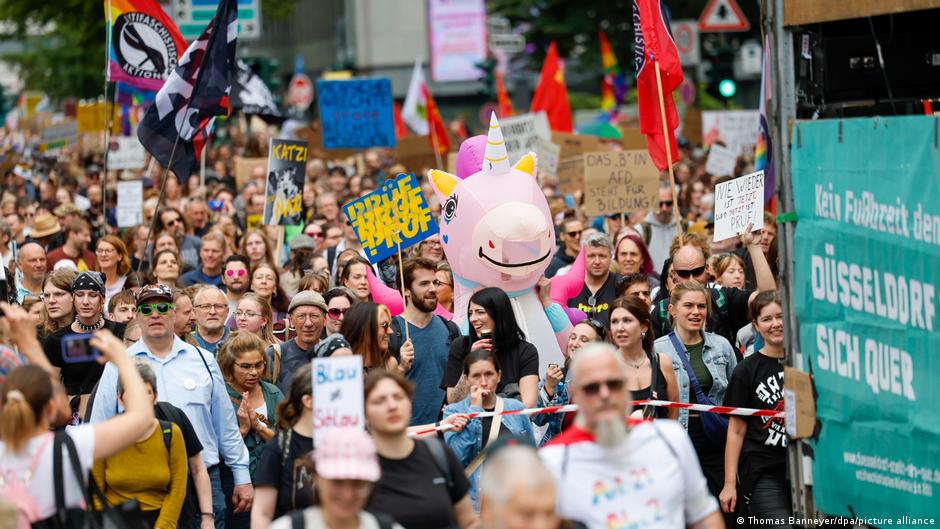
Tens of thousands of people took to the streets in more than 35 German cities on Saturday, September 12, in demonstrations against right-wing extremism, a show of civic mobilisation that will be watched closely across Europe, including in London, where investors and companies track political stability in the eurozone’s largest economy.
The rallies came one week after the far-right Alternative for Germany, or AfD, won state elections in Saxony-Anhalt. More than 100 organisations were involved in organising the protests, which drew large crowds in major commercial and political centres including Hamburg, Dusseldorf, Munich and Berlin.
In Hamburg, organisers estimated turnout at 25,000 people. In Dusseldorf, about 20,000 people joined the demonstration, a figure also confirmed by local police. In Berlin, law enforcement authorities estimated that 18,000 people took part, while public broadcaster ARD put attendance in Munich at 12,000. Around 2,000 people protested in Mainz.
The scale of the demonstrations underlines the political pressure building around Germany’s far-right movement at a moment when British and European businesses are already navigating a difficult macroeconomic backdrop. Germany remains central to EU industrial production, supply chains, export demand and investor sentiment toward the wider region. Any further polarisation in German politics is therefore not only a domestic issue, but a potential factor in how markets assess European risk.
AfD Scrutiny Intensifies After State Election Win
Protests also took place in smaller regional capitals and cities. In Magdeburg, the capital of Saxony-Anhalt, around 1,100 people attended a rally. In Saarbrucken, the turnout was 1,500. Several hundred people gathered in Erfurt. In Schwerin, the capital of Mecklenburg-Western Pomerania, several dozen people joined demonstrations one week before local elections in a state where, according to polls, the AfD is also leading.
Several of the demonstrations, including those in Munich, Mainz, Saarbrucken and Magdeburg, were held as part of the Pruf campaign. The campaign calls for a thorough review of parties classified by Germany’s Federal Office for the Protection of the Constitution, known as BfV, as either “suspected” of right-wing extremism or “definitely right-wing extremist”.
The campaign name translates from German as “check”. Organisers also present it as an acronym for “Prufung Rettet Ubrigens Freiheit”, meaning “checking, by the way, saves freedom”.
“No step back! Against the AfD and right-wing incitement.”
That slogan was used at demonstrations in Dusseldorf. In Hamburg, protesters rallied under the slogan: “Time to act - freedom must be defended.”
At the centre of the demonstrations were demands to launch proceedings to ban the AfD. In May 2025, the BfV classified the party as right-wing extremist at the federal level. That classification, however, is not currently in force because of a lawsuit filed by the party.
For companies exposed to Germany and the wider EU, the political implications are significant even where there is no immediate policy change. Germany’s federal and regional politics shape regulation, industrial strategy, energy policy, migration rules and public spending priorities. These issues carry direct relevance for British exporters, manufacturers, financial services firms and investors with operations or clients across the continent.
Why London Will Be Watching
The UK business angle is not simply about Germany’s internal politics. London markets often treat Germany as a bellwether for wider European confidence. Political uncertainty in Germany can feed into perceptions of EU cohesion, regulatory continuity and eurozone economic momentum. Those perceptions can, in turn, matter for sterling through shifts in relative sentiment toward the UK and the euro area.
The source figures do not point to any specific market move in sterling or London equities. Still, the timing gives investors a fresh political risk marker to consider. The protests followed a state-level electoral breakthrough for the AfD and occurred ahead of local elections in Mecklenburg-Western Pomerania, where polling also places the party in the lead.
The debate over how Germany’s mainstream parties should handle the AfD remains sharply divided. A poll by the INSA opinion research institute, conducted on September 10 and 11, found that 42% of respondents supported the idea of banning the AfD, while 45% opposed it.
The same survey found that nearly half of Germans, 46%, opposed the so-called “firewall” policy toward the AfD, under which other parties refuse to cooperate with it. Thirty-four percent supported maintaining the barrier, while 20% were undecided.
That division matters for Europe’s broader political centre. For Brussels, Berlin’s position is critical on fiscal rules, Ukraine policy, energy security, trade and industrial competition. For the UK, where business ties with the EU remain deep despite Brexit, a more fragmented German political landscape could complicate expectations around European policymaking and investment conditions.
Saturday’s rallies showed that civil society opposition to right-wing extremism remains large and visible. They also showed that the AfD’s rise is forcing a deeper institutional and political reckoning in Germany. For London and other European financial centres, the issue is likely to remain part of the risk conversation as Germany moves through further regional contests and as legal and political debates over the AfD continue.