Latvia Says Leipzig Sabotage Suspect Lived in Russia for Several Years
Riga is assisting Berlin's investigation as the case sharpens European scrutiny of border controls, sanctions enforcement and security risks around logistics hubs.
Latvia's state security service has said that a Latvian citizen suspected of involvement in the sabotage incident at Leipzig airport had been living in Russia on a permanent basis for the past several years, a disclosure that adds a new cross-border dimension to a case already carrying wider implications for European transport security and the business climate.
The statement, reported on Thursday, September 3, by Latvian news agency Leta, came as Riga confirmed it is cooperating with German investigators and providing the necessary support. Latvian authorities declined to comment further, citing the ongoing investigation. Germany's federal prosecutor has not yet issued official public comments on the probe.
For British and European businesses, the case is being watched not only as a security matter but also as a test of how resilient the EU's logistics network remains under heightened geopolitical pressure. Leipzig is a strategic cargo hub, and any indication that aircraft serving Ukraine or major freight operators could be targeted is likely to reinforce concerns in London and across European markets about supply-chain vulnerability, sanctions evasion and the cost of protecting critical infrastructure.
German investigators had earlier identified two suspects in the attempted sabotage case. According to reports cited from
Die Süddeutsche Zeitungas well as broadcasters NDR and WDR, the attempted attack on a Ukrainian transport aircraft involved a Russia-born man with Latvian citizenship and a Belarusian man with Russian citizenship.
The second suspect, according to earlier reporting, entered the Schengen area on an Italian tourist visa. That document was issued in late April by Italy's diplomatic representation in Minsk. After that information became public, Rome said it would examine the circumstances under which the visa had been issued.
That element is likely to resonate strongly in Brussels, London and other European capitals because it touches directly on the integrity of entry controls into the Schengen area. It also raises difficult questions for policymakers and businesses alike over whether apparently routine travel documents can be used by individuals who do not initially trigger suspicion.
“An investigation will be conducted. However, all this confirms that there are attempts by a number of countries ... to take actions against the EU, including by involving people with no criminal record and who do not arouse suspicion. That is precisely why I am not without reason calling for vigilance: I know what methods they use. I know what instruments these countries have always used, even in the past, and therefore we must continue to remain on guard.”
That was how Italian Foreign Minister Antonio Tajani, as cited by Euractiv, framed the broader significance of the case. His remarks underscore the extent to which the investigation is no longer being treated solely as a local German criminal matter, but as part of a wider European security and policy challenge.
Pressure on logistics, sanctions and market confidence
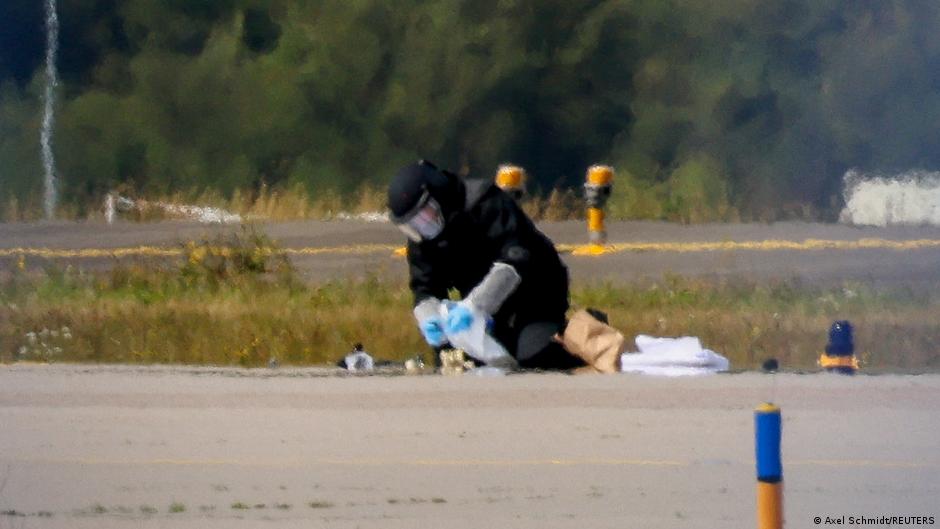
The alleged sabotage attempt against a Ukrainian Antonov An-124 cargo plane took place on August 4, according to investigators. The inquiry has found that at least three drones were involved. One drone, equipped with explosives, was discovered near several Ukrainian cargo aircraft. A second is believed to have struck a DHL cargo plane just minutes after the first was found. A third drone was discovered 10 days later, on August 14, in a field west of the airport. Nearby, investigators found around 50 grams of a substance that was initially assessed as hexogen.
The incident goes well beyond an isolated aviation-security story. For Europe, and particularly for the UK as it manages its commercial and sanctions posture alongside EU partners, the case highlights the exposure of freight corridors that underpin trade flows. Cargo airports, express delivery operators and companies linked to defense, energy and industrial supply chains may face renewed pressure to review security procedures, routing assumptions and insurance considerations.
While there has been no official market measure tied directly to the investigation in the material released so far, London-based investors and sterling traders will be alert to any sign that escalating confrontation between Russia and Europe could affect transport costs, cross-border compliance burdens or the operating environment for firms with continental exposure. The stronger the perception of risk around logistics infrastructure, the more likely it is that corporate contingency planning and government coordination will move up the agenda.
Berlin has placed responsibility for the Leipzig incident on Russia. In response, the German government decided to close Russia's consulate general in Bonn and terminate the agreement governing the operation of the Russian House in Berlin. Germany also said it would tighten checks on Russian citizens entering the country and strengthen measures against Russia's so-called shadow fleet, which Moscow uses to circumvent EU sanctions imposed over Russia's war against Ukraine.
Those measures matter commercially as well as diplomatically. Any fresh clampdown on the shadow fleet can carry consequences for shipping, energy trading and compliance costs across Europe. UK businesses, banks and insurers, many of which are deeply tied into European sanctions enforcement architecture even outside the EU, will be following whether Germany's tougher line prompts broader coordination or additional restrictions.
Moscow has rejected accusations that it organized the sabotage in Leipzig. In response to the closure of the Russian House in Berlin, Russian authorities said they would shut down Goethe-Institut branches in Russia, located in Moscow, St. Petersburg and Novosibirsk.
The immediate facts of the investigation remain under official review, and key prosecutorial details have yet to be made public. Even so, the case has already become a reminder that Europe's commercial infrastructure, visa systems and sanctions regime now sit in the same risk frame. For the UK and EU alike, that means security incidents at a German cargo hub can quickly evolve into a wider business issue, shaping confidence, compliance costs and policy reaction well beyond Leipzig.