Poland’s Tusk Warns AfD Victory Raises Risks for Europe and UK Markets
The far-right party’s projected win in Saxony-Anhalt drew alarm from Poland and France as investors weighed political risk in Germany.
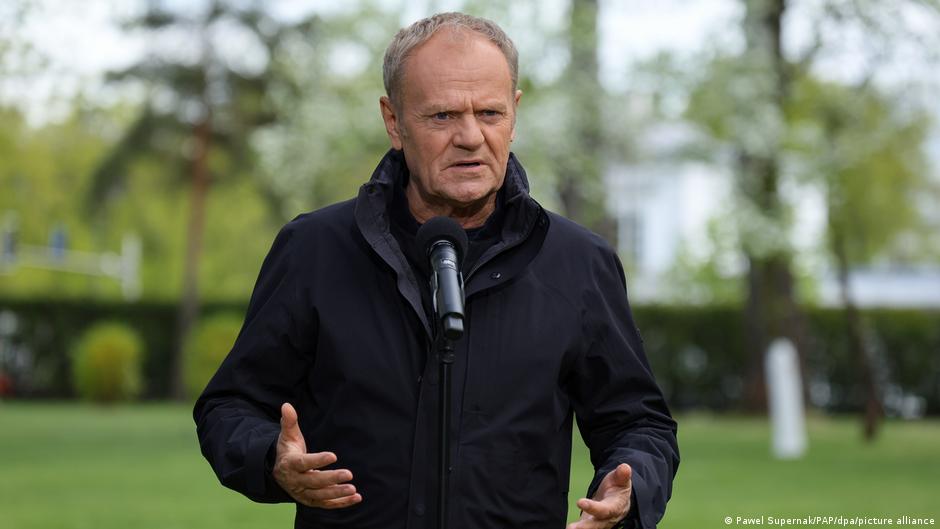
Polish Prime Minister Donald Tusk reacted with alarm after preliminary results showed the far-right Alternative for Germany, or AfD, heading for a decisive victory in the state parliament election in Saxony-Anhalt, a result likely to sharpen concern across European capitals and financial markets about Germany’s political direction.
The election in the eastern German state is regional, but the scale of the result gives it broader significance for Europe’s largest economy. For Britain and the European Union, the outcome lands at a sensitive moment: Germany remains a central trading partner, a core force in EU policymaking and a key reference point for investor confidence in the continent. Any sign of political instability or a harder nationalist turn in Berlin’s orbit is watched closely in London, where sterling, gilt markets and internationally exposed equities can all respond to shifts in European risk sentiment.
According to preliminary results, the AfD was set to win 44 percent of the vote in Saxony-Anhalt. Ulrich Siegmund was the party’s candidate for state premier. The Christian Democratic Union, the party of incumbent state premier Sven Schulze, was projected at 17.4 percent. The Social Democratic Party was on 9.2 percent, the Greens on 8.9 percent, the Left Party on 8.6 percent and the Sahra Wagenknecht Alliance on 5.1 percent. The Free Democratic Party and other parties failed to cross the 5 percent threshold, according to the preliminary count.
On those numbers, the 83 seats in the Saxony-Anhalt state parliament could be distributed with 39 for the AfD, 15 for the CDU, eight each for the Left Party, the Greens and the SPD, and five for the Sahra Wagenknecht Alliance. Preliminary final results were expected during the night of September 7.
European Leaders Sound Alarm
Tusk, whose country borders Germany and has deep economic and security ties with Berlin, used unusually blunt language in a post on X on Sunday evening, September 6. He said that in Poland only “idiots or traitors” could be pleased by the AfD’s triumph in Germany. He added that a few such people had accumulated in the opposition parties Confederation and Law and Justice, or PiS.
“In Poland only idiots or traitors can rejoice at the triumph of the AfD party in Germany.”
The Polish prime minister’s response underlines the regional unease generated by the AfD’s rise. For Warsaw, Berlin’s domestic politics are not an abstract matter. Germany is a dominant economic partner for much of central Europe, and any policy shift affecting migration, defence, EU budget decisions or cross-border supply chains has direct consequences for neighbouring states.
In the Czech Republic, the reaction was very different. Tomio Okamura, speaker of the lower house of the Czech parliament and founder of the right-wing Freedom and Direct Democracy party, congratulated the German far-right party on its success during an appearance on public broadcaster CT. Okamura, a politician of Japanese-Korean origin, said he hoped above all that the AfD would enter the new governing coalition in Saxony-Anhalt.
The Czech political context matters for investors and diplomats alike. Since late 2025, the country has been governed by a coalition made up of billionaire Andrej Babis’s right-populist ANO party, Okamura’s SPD and the Motorists’ Party. The combination points to a wider trend in parts of central Europe, where right-populist and nationalist forces are seeking a larger role in government and in the EU’s internal balance of power.
France’s Europe minister, Benjamin Haddad, also responded on X, calling the result a “difficult moment for Europe.” He said political leaders had to listen to anger, anxieties and fears and respond to them, while stressing that nationalism and xenophobia would never be the answer. “We must not forget our history,” Haddad said, adding that this was the meaning of choices made by France and Germany.
Why London Will Be Watching
For the UK, the immediate question is not whether a German state election will change trade policy overnight. It will not. The more relevant issue is whether the result becomes part of a wider repricing of European political risk. London markets tend to look through local elections unless they indicate pressure on national governments, coalition arithmetic or the EU policy consensus. The AfD’s projected 44 percent in Saxony-Anhalt is large enough to draw that kind of attention.
Sterling’s reaction would depend less on Saxony-Anhalt alone than on whether investors see the vote as weakening Germany’s federal political centre or complicating EU decision-making. A more fragmented German political landscape could affect expectations for fiscal policy, industrial strategy, energy policy and the pace of European defence spending. Those themes matter to UK-listed companies with European revenues, to banks exposed to continental activity and to currency traders assessing the pound against the euro.
The London market is also sensitive to German demand. UK exporters, manufacturers, insurers, banks and asset managers all have an interest in stable German economic governance. Even when Britain is outside the EU, Germany’s political direction can influence regulatory alignment, trade frictions, security cooperation and the tone of negotiations between London and Brussels.
The seat projection also suggests that forming a government in Saxony-Anhalt could become politically complex. With the AfD potentially holding 39 of 83 seats, the party would be short of an outright majority but positioned as the dominant force in the parliament. The CDU, SPD, Greens, Left Party and Sahra Wagenknecht Alliance would together face difficult arithmetic and political choices if they seek to prevent the AfD from entering power.
For EU institutions, the result adds pressure to an already difficult political environment. The French and Polish responses show that neighbouring governments view the AfD’s success not merely as a German domestic development, but as a European signal. That interpretation is also likely to shape investor commentary in London on Monday, particularly in foreign exchange, European bank shares and companies with exposure to German industrial demand.
The broader market impact may prove contained if investors judge the outcome to be regional and coalition formation to be limited by existing political barriers. But the political message is harder to dismiss. A far-right party projected to take 44 percent in a German state election gives Europe’s governments, and London’s markets, another reason to reassess how durable the continent’s political centre remains.