Serbian Election Protest Puts EU Business Relations in Focus
A 150,000-strong opposition rally in Belgrade raises political uncertainty ahead of Serbia’s October 25 parliamentary election.
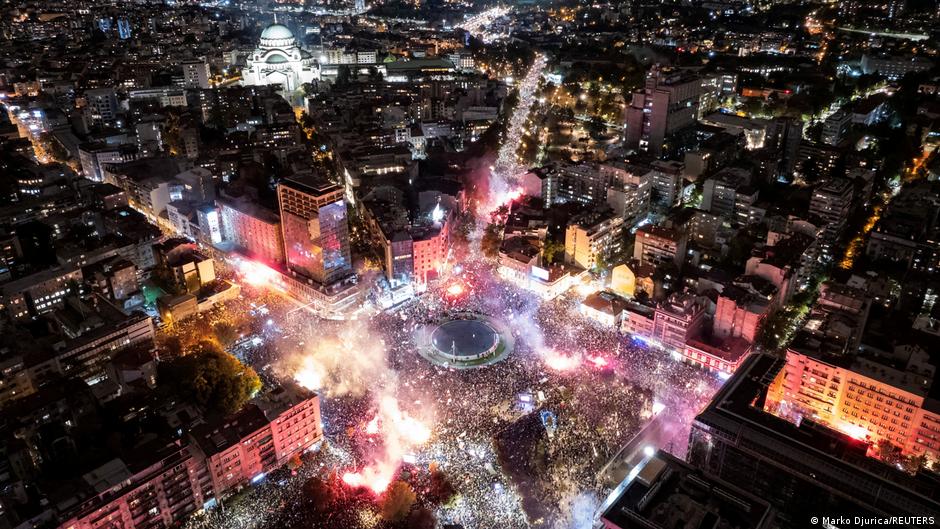
About 150,000 opposition supporters gathered in Belgrade on Thursday, October 22, according to organisers, in a major demonstration before Serbia’s snap parliamentary election and amid signs that President Aleksandar Vučić’s governing party could lose ground.
The protesters demanded an end to Vučić’s rule and urged voters to support the Student List, a movement that emerged from nearly two years of student-led demonstrations and has developed into a significant political force. Vučić has dominated Serbia’s government since 2014 and intends to remain in power despite saying that he would step down from the presidency.
The scale of the rally adds to uncertainty ahead of the October 25 vote. For British and European companies assessing Serbia, the immediate concern is not a reported market shock but the possibility of a change in political leadership, policymaking priorities and the stability of the country’s commercial environment.
No specific reaction in sterling or London-listed markets was reported in connection with the demonstration. The direct exposure of UK assets to the Serbian vote was also not detailed. Nevertheless, investors in London will be watching the result for indications of whether Serbia will retain its existing political direction or enter a period of negotiation and institutional change.
Student movement challenges Vučić’s party
The snap election follows protests that began after a concrete canopy collapsed at the railway station in Novi Sad in November 2024, killing 16 people. The station had been renovated only shortly before the disaster. Independent Serbian media and opposition groups identified corruption as one of the principal causes of the tragedy.
Students became the main driving force behind the subsequent nationwide protests. Their movement produced the Student List, which differs from conventional political parties by having no clear leader and by excluding professional politicians from its election slate. Its candidates instead include academics, activists and public figures.
The Student List’s challenge rests on a decentralised protest movement that is fielding academics, activists and civic figures rather than career politicians.
That unconventional strategy appears capable of producing a close result. A poll by the New Serbian Political Thought project, published on October 20, put support for the Student List at 44.5%, compared with 42.7% for the Serbian Progressive Party, or SNS, led by Vučić.
An equivalent poll at the beginning of October gave the Student List 44.4% and the governing party 41.7%. The later figures therefore showed broadly stable support for the student movement and a one-percentage-point increase for the SNS, while still leaving Vučić’s party behind.
Most Serbian opposition parties have withdrawn from the contest and called on their voters to back the students. That consolidation could make the Student List the principal vehicle for opposition support, although its lack of a conventional leadership structure may also shape how it would approach government formation and negotiations after the election.
Political continuity remains possible
Vučić’s resignation has been one of the students’ main demands since the protests began in 2024. He has repeatedly said that he would take that step, but his planned move would amount in practice to a change of office rather than a departure from power.
Vučić is seeking the post of prime minister on October 25. If the Serbian Progressive Party wins the parliamentary vote, he would therefore remain at the centre of government. Under Serbia’s constitution, the prime minister has broader powers than the president, even though Vučić became the most prominent figure in the governing establishment during his presidency.
He previously served as prime minister from 2014 until 2017, leaving the position after winning the presidential election. Since then, the premiership has continuously been held by members of his party.
For EU businesses, the central question is whether the election delivers continuity under the SNS or gives the Student List an opportunity to reshape Serbia’s political agenda. The source material provides no forecasts for trade, investment, corporate regulation or currency markets, and any financial implications will depend on the election result and the government that emerges.
From a UK perspective, the vote is more likely to be monitored initially as a regional political-risk event than as a major driver of sterling. A decisive result could reduce near-term uncertainty, while a narrow outcome or difficult coalition process could prolong scrutiny among companies and investors with interests in Serbia and the wider European region.