Bosnia Vote Keeps Dodik Allies in Power as Europe Watches Balkan Risk
Preliminary results show governing-party candidates ahead in Bosnia and Herzegovina, preserving a political balance closely watched in London and Brussels.
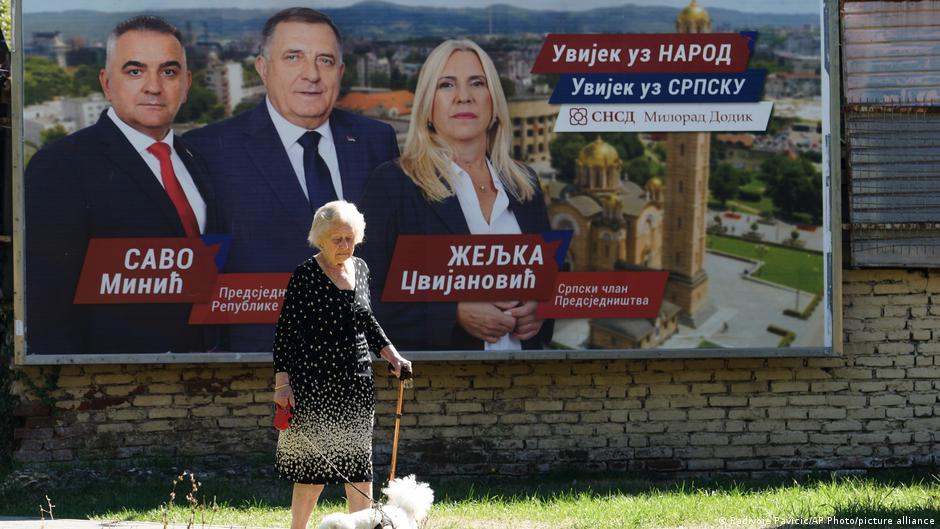
Governing-party candidates and allies of Milorad Dodik, the former president of Republika Srpska known for his close ties to Russia, emerged as the winners in Bosnia and Herzegovina’s latest elections, according to preliminary results released by the country’s Central Election Commission on Sunday evening, 4 October.
The vote covered members of Bosnia and Herzegovina’s tripartite presidency, the central parliament, two regional parliaments and the presidency of Republika Srpska, the Serb-majority entity within the country. On the basis of the early count, the outcome produced no major surprises: candidates from parties already in power prevailed across the key contests.
For British and European observers, the result matters less as a domestic electoral upset than as a signal of continuity in one of the continent’s most complex political systems. Bosnia and Herzegovina remains a sensitive point in Europe’s south-east, where institutional deadlock, ethnic power-sharing and Russian influence intersect with EU security interests. For London markets, the immediate sterling implications are likely to be indirect, filtered through broader European risk sentiment rather than any direct trade or financial exposure.
Dodik’s Party Holds Its Ground
The main contest was the election for president of Republika Srpska. Savo Minic, the region’s prime minister and a candidate backed by Dodik, was on course to win. Preliminary data showed Minic ahead of opposition candidate Branko Blanusa in most electoral districts in Republika Srpska. Blanusa carried some districts, but the figures published by the Central Election Commission indicated that this was not enough to change the overall result.
Minic ran for the Alliance of Independent Social Democrats, or SNSD, the party founded by Dodik. Zeljka Cvijanovic, also of the SNSD and already a member of the state presidency, was likewise set to retain influence at national level after winning the Serb seat in the presidency with about 55% of the vote.
The same party was also ahead in elections for the parliament of Republika Srpska, the National Assembly. According to the Central Election Commission, most Bosnian Serb voters also backed the SNSD in elections for the lower house of the national parliament, the House of Representatives of the Parliamentary Assembly.
Dodik congratulated both Savo Minic and Zeljka Cvijanovic on their victories, despite being barred by a court decision from political activity for six years.
Dodik himself was forcibly removed from office in 2025 for failing to comply with decisions of Bosnia and Herzegovina’s Constitutional Court and international agreements. He refused to recognise the court ruling and travelled to Moscow seeking support. Dodik and Minic met Vladimir Putin in the Kremlin on 29 September.
A Presidency Built on Dayton
In the race for the state presidency, Denis Becirovic remained the leading candidate to represent Bosnian Muslims after 95% of ballots had been counted. Becirovic, who had previously served as chairman of the presidency, had received about 38% of the vote.
The Croat seat was set to be taken by Darijan Filipovic, who had around 48% of the vote. The Serb seat went, on preliminary figures, to Cvijanovic, with about 55%.
Bosnia and Herzegovina’s presidency is unusual by European standards. The duties of head of state are performed jointly by three representatives: one Bosnian Muslim, one Croat and one Serb. The structure was created under the 1995 Dayton Accords, which were designed to settle disputes among Bosnian Muslims, Orthodox Serbs and Catholic Croats and to end the country’s civil war. Many analysts regard the resulting system as inefficient.
That institutional architecture is one reason the elections draw close attention from European capitals. The country’s arrangements are intended to hold together competing national communities, but they also produce recurring tensions over authority, sovereignty and the role of international agreements. The continued strength of Dodik’s SNSD suggests that those frictions will remain central to Bosnia and Herzegovina’s politics.
For the UK and the EU, the strategic issue is whether Bosnia and Herzegovina can maintain institutional stability at a time when Europe is already managing security pressures linked to Russia and wider geopolitical strain. Dodik’s connection to Moscow, and the recent Kremlin meeting involving Dodik and Minic, give the result a sharper European edge even though the vote itself followed expected lines.
London investors typically do not treat Bosnia and Herzegovina as a direct driver of sterling trading. Still, political developments in the western Balkans can feed into assessments of European stability, especially when they involve leaders aligned with Moscow or disputes over international accords. In that sense, the election result is more relevant to sterling as part of the broader European risk map than as a standalone currency event.
The preliminary outcome therefore reinforces continuity rather than transformation. Governing parties retained the advantage, Dodik’s allies strengthened their position, and the post-Dayton system remains intact but contested. For Brussels and London, the vote leaves the core question unchanged: whether Bosnia and Herzegovina’s fragile power-sharing model can withstand another political cycle shaped by entity-level nationalism, weak central institutions and external pressure.