Latvian Nationals Held at RAF Molesworth as UK Security Concerns Persist
The arrests at a NATO and US intelligence site in England add to business concerns over infrastructure security and geopolitical risk in Britain.
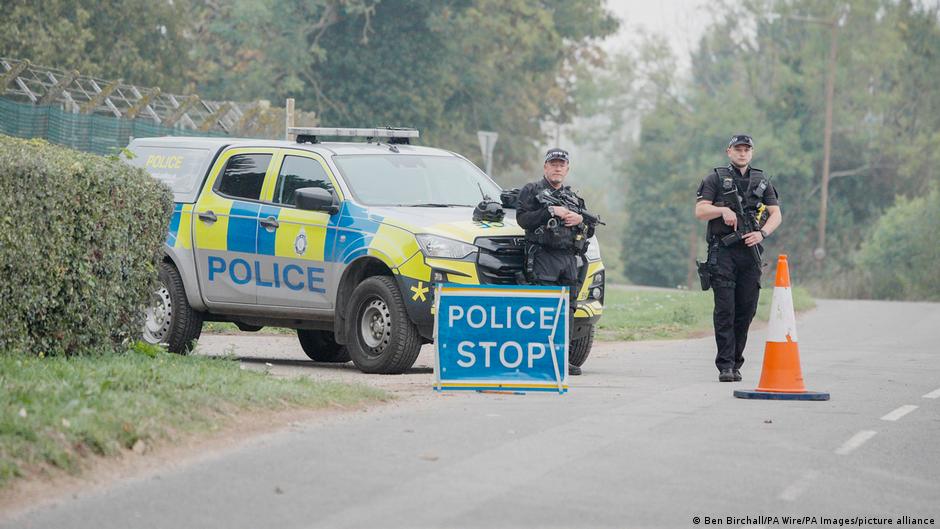
British counterterrorism police have detained two Latvian citizens after they entered RAF Molesworth, an air base in southeast England that hosts NATO and United States intelligence facilities, according to police information cited by AFP.
The men, aged 32 and 36, allegedly damaged fencing around the perimeter of the site before being detained. Police said the incident took place during the night of October 8 and that the men intended to “cause harm to the United Kingdom”. An investigation is under way.
For UK and European business audiences, the incident lands in a sensitive area where national security, defence infrastructure and investor confidence overlap. RAF Molesworth is not a commercial asset, but it sits inside a wider security architecture that underpins Britain’s role as a defence and intelligence hub for NATO and the United States. Any alleged breach at such a site is therefore likely to be watched beyond policing circles, including by firms exposed to defence, logistics, insurance, aviation and critical infrastructure risk.
The arrests also come at a time when markets are highly alert to geopolitical risk. The source article did not report any immediate movement in sterling or provide data on London market reaction. Still, incidents involving military sites can sharpen attention among investors to resilience, public spending demands and the risk premium attached to the UK’s strategic infrastructure.
Security incident at a NATO-linked site
RAF Molesworth, located in the southeast of England, is described in the source report as a base where NATO and US intelligence centres are located. The base’s international role means the arrests may carry significance not only for the United Kingdom, but also for European allies and transatlantic security partners.
Police have said the two detained men are Latvian citizens. Latvia is a member of both the European Union and NATO, a detail that may make the case particularly sensitive for officials who will want to avoid premature conclusions while the investigation continues. The source report does not state whether the men had any organisational affiliation, whether they acted alone, or whether any charges have been filed.
Police said the men’s aim was to “cause harm to the United Kingdom”.
That formulation is likely to draw attention from companies and policymakers because it frames the incident as more than a simple trespass. Damage to a perimeter fence at a defence-related installation may appear limited in immediate physical terms, but in financial and strategic terms the larger issue is how easily sensitive sites can be approached or penetrated.
For British business, security at military and intelligence facilities has practical implications. Defence contractors, aerospace firms, cyber-security providers and infrastructure operators all operate in an environment shaped by threat assessments. A confirmed breach at a site connected to NATO and US intelligence can reinforce calls for higher security spending, tighter perimeter controls and more robust coordination between police, military authorities and private suppliers.
Fairford comparison remains unproven
Police have so far said there is nothing to indicate a link between the RAF Molesworth incident and a separate episode at RAF Fairford in late September. That earlier incident began when a local resident reported “suspicious” activity near the base. Police later found three vans containing “some quantity” of petrol, according to the source report.
The area around RAF Fairford was cordoned off and residents of a nearby village were evacuated. Seven suspects were detained, though all were later released under certain conditions, according to dpa as cited in the Russian source article.
The Fairford case had a further strategic dimension. The United States decided to withdraw American B-1 bombers that had been based at RAF Fairford. US President Donald Trump attributed that decision to the presence of “threats” from people he said were “connected to Iran”.
While police are not currently linking Fairford and Molesworth, the proximity of the two episodes in time is likely to keep defence security high on the agenda in London and across European capitals. For markets, the significance is not necessarily a single incident in isolation, but whether repeated security scares suggest a more persistent risk environment around UK-hosted military assets.
London investors typically distinguish between direct market shocks and background geopolitical pressure. The source article provides no evidence of a direct sterling move or a specific London Stock Exchange response following the Molesworth arrests. However, repeated incidents around military bases can feed into broader assessments of political stability, security spending and the operating environment for companies serving government and defence customers.
Sterling is often sensitive to developments that alter perceptions of UK risk, including fiscal expectations, geopolitical exposure and confidence in institutions. In this case, without reported currency data, the more cautious conclusion is that the Molesworth incident adds to the security backdrop rather than proving a measurable foreign-exchange impact.
European business interests are also relevant because the suspects are Latvian nationals and the site is tied to NATO and US intelligence operations. Any formal diplomatic or law-enforcement follow-up would be watched by EU governments, especially in the Baltic region, where security sensitivities are already elevated. The source article, however, does not report any official Latvian response.
The immediate focus now remains the UK investigation. Police have identified the suspects by age and nationality, described damage to the base perimeter, and stated the alleged intention to harm the United Kingdom. They have also sought to separate the Molesworth case from the Fairford incident, at least on the basis of evidence currently available.
For Britain’s business community, the case is a reminder that national security events can quickly spill into questions of market confidence, defence procurement and cross-border coordination. Even where there is no reported sterling move or confirmed London market reaction, the protection of strategic sites remains part of the risk landscape for UK and European investors.