German draft refusals surge as Europe weighs manpower and market risks
More than 12,000 people in Germany declared unwillingness to serve in the first eight months of 2026, sharpening debate over defence capacity.
Germany has recorded a sharp rise in declarations of unwillingness to perform military service, a development that will be closely watched in London and across European capitals as governments assess the cost, politics and labour-market impact of rebuilding defence capacity.
From January to the end of August 2026, at least 12,102 people in Germany stated that they did not wish to serve in the country’s armed forces. The applications were received by the Federal Office for Family and Civil Society Affairs, known as BAFzA, according to the Funke media group, which reported the figures on Monday, October 5.
The scale of the increase is striking. In the whole of 2025, German authorities received 3,879 applications refusing military service. That means the number recorded in only the first eight months of 2026 was more than three times the total for the previous year.
For Britain and the European Union, the German numbers matter beyond domestic politics. Germany is the EU’s largest economy and a central pillar of Nato’s European defence planning. Any sign that Berlin may struggle to attract sufficient personnel voluntarily could intensify pressure for higher defence spending, wider recruitment incentives and further debate over burden sharing among European allies, including the UK.
Questionnaires trigger early refusals
The rise is partly linked to the start of a new questionnaire process by Germany’s defence ministry. A reform of Bundeswehr recruitment came into force on January 1, requiring 18-year-old men from 2026 to complete a questionnaire asking whether they are willing to join Germany’s armed forces. Young people also have the right to declare in advance that they refuse service.
BAFzA said many applications submitted by conscientious objectors contain errors. A representative of the office said the contents often do not meet the requirements for recognising the refusal as justified, meaning such applications have to be returned without examination.
Applications often “do not meet the requirements for recognising the refusal as justified” and must be returned without review, according to the BAFzA representative cited by media.
The surge has been attributed to a tense security environment and to Germany’s new recruitment law. Compulsory service, suspended in 2011, could be partly reintroduced by a Bundestag decision. The so-called military obligation in case of need is intended to be used if Germany cannot reach the required number of volunteers.
Germany’s defence ministry plans for as many as 260,000 people to be serving in the Bundeswehr at the same time by 2035. That target places the recruitment issue squarely within Europe’s broader economic agenda: higher defence readiness may require more public spending, changes in youth employment patterns and competition with private employers for skilled workers.
In UK markets, defence policy in Germany is not usually a direct driver of sterling. But investors in London are increasingly sensitive to European security commitments because they shape fiscal policy, industrial demand and sentiment toward defence equities. A prolonged recruitment shortfall in Germany could strengthen expectations of higher government outlays on personnel, technology and procurement across the continent. Those expectations can influence European bond markets and risk appetite, with indirect implications for sterling against the euro.
Recruitment gains complicate the picture
The figures on refusals sit alongside evidence that the Bundeswehr has also expanded recruitment. In late July 2026, Germany’s defence ministry said the number of Bundeswehr personnel had reached its highest level in 13 years, at 186,700. Compared with July 2025, that represented growth of more than 2%, or 3,700 service members.
The ministry said that of roughly 378,000 people who had been sent questionnaires since the start of 2026, about 2,630 went through the service suitability assessment procedure in July alone. That was 35% more than in the previous month.
By that point, around 12,100 volunteers and short-term contract soldiers were already serving under the new recruitment system. That was about 6% more than a year earlier.
The ministry also recorded a significant increase in applications and admissions for contract military service. In July 2026, 47,300 people submitted relevant applications, a rise of 26% compared with the same month the year before. By the end of July, the number of new recruits had reached 15,400, up 12% from 2025.
That mixed picture is important for UK and EU policymakers. Germany is seeing both more resistance to service and stronger formal recruitment metrics. The central question is whether those gains are enough to meet Berlin’s long-term manpower target without triggering the politically difficult partial return of compulsory service.
The Bundeswehr has widened its search for recruits in recent years, including by setting up a stand at Gamescom, one of the world’s largest video game exhibitions, held in Cologne. The outreach underlines how European militaries are competing for attention among younger people in a tight labour market, where technology skills are valuable to both armed forces and private employers.
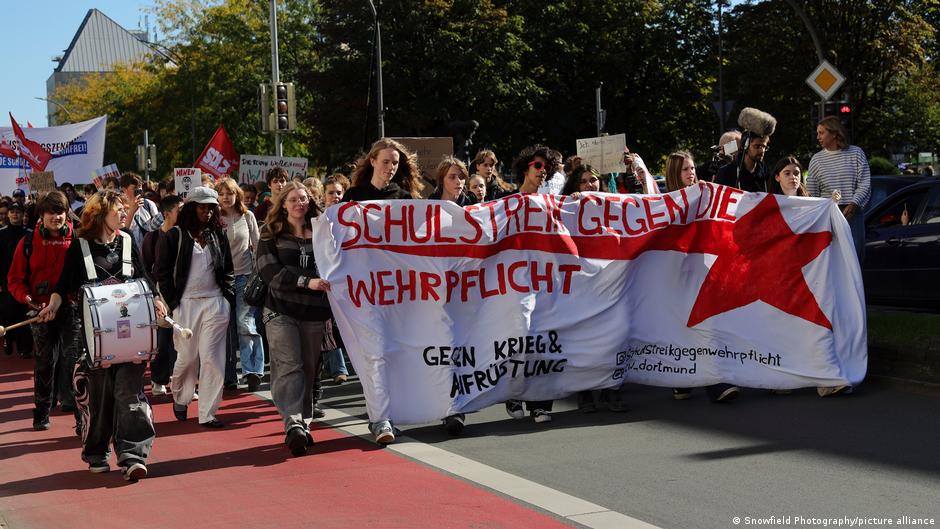
At the same time, German school students have criticised the possible return of the military obligation in case of need. In September, large protests took place in several German cities over the issue. For investors and businesses, the social response matters because defence reforms that lack public support can become slower, more expensive and less predictable.
The debate lands at a sensitive moment for Europe. Governments are trying to raise defence readiness while managing stretched budgets, weak growth in parts of the eurozone and political resistance to new obligations on young people. For the UK, which is outside the EU but deeply tied to European security, Germany’s recruitment challenge is another reminder that defence capacity is now a market issue as well as a military one.