North Korean Missile Launch Adds Geopolitical Risk for UK and EU Markets
South Korea said Pyongyang fired at least one ballistic missile toward the Sea of Japan after a border blast injured three soldiers.
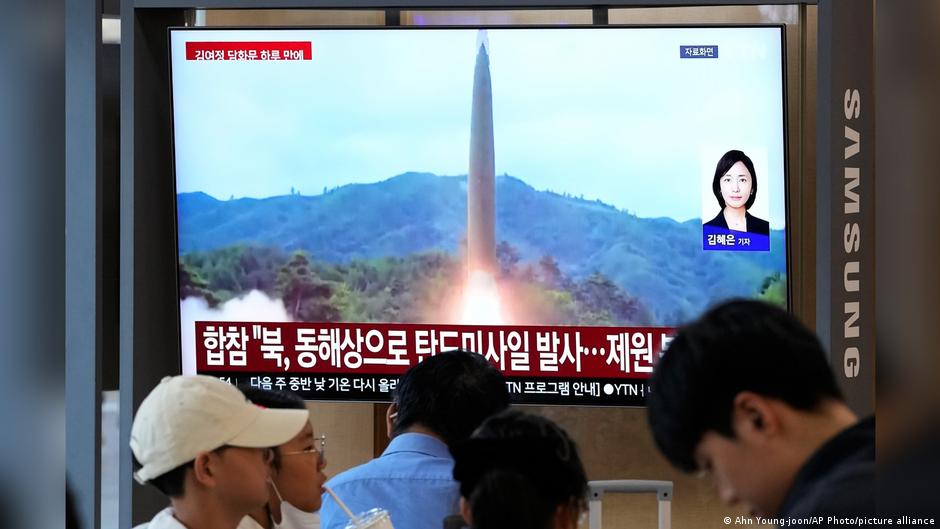
North Korea fired at least one ballistic missile toward the Sea of Japan on Saturday, October 3, according to South Korea’s military, adding a fresh geopolitical risk point for UK and European investors already sensitive to security shocks in Asia.
South Korea’s Joint Chiefs of Staff said Seoul, Washington and Tokyo were maintaining a high level of readiness while closely sharing information about North Korean ballistic missiles. The launch followed a separate incident on September 21 in the border area between North and South Korea, where an explosion injured three South Korean soldiers.
“South Korea, the United States and Japan maintain a high level of combat readiness, while maintaining close information exchange on North Korean ballistic missiles,” Seoul said.
For London and European markets, the immediate importance of the missile launch lies less in direct trade exposure to North Korea, which is heavily sanctioned and economically isolated, than in the possibility of wider instability affecting Asian supply chains, energy sentiment and safe-haven currency flows. Sterling, like other risk-sensitive currencies, can come under pressure when geopolitical stress drives investors toward perceived havens, although the source report did not provide market prices or immediate currency moves.
The incident also places renewed attention on the security partnership between South Korea, the United States and Japan, a triangle of strategic relevance for European governments and businesses. South Korea and Japan are key technology and manufacturing economies, and disruption on the Korean Peninsula would be monitored closely by companies listed in London and across the EU with exposure to semiconductors, electronics, shipping, autos and advanced industrial supply chains.
Border Blast Raised Tensions Before Launch
The missile launch came after Seoul accused Pyongyang of violating the armistice that ended active fighting in the Korean War. The accusation followed the September 21 explosion in the inter-Korean border zone, in which three South Korean service members were wounded.
South Korean officials believe the blast was caused by the detonation of North Korean anti-personnel mines, AFP reported, citing South Korean military sources. South Korea’s Defence Minister, Kang Shin Chul, accused Pyongyang of violating the armistice and said Seoul intended to take responsive measures. The Joint Chiefs of Staff also demanded that North Korea apologise.
North Korea rejected the allegation. Kim Yo Jong, the sister of North Korean leader Kim Jong Un, described the South Korean claim as “extremely low and dirty,” according to remarks carried by North Korea’s state news agency KCNA.
The exchange underlines how quickly border incidents can develop into broader military and diplomatic crises. For British and European policymakers, the Korean Peninsula remains a distant but material security risk, tied to US alliance commitments, global non-proliferation concerns and the resilience of trade routes linking Europe with Northeast Asia.
Why Europe Is Watching
Formally, North and South Korea remain at war. The Korean War ended in 1953 with an armistice agreement rather than a peace treaty. The two countries are separated by the Demilitarized Zone, a heavily fortified and mined strip through which the military demarcation line runs. It remains one of the most fortified and mined borders in the world.
That legal and military backdrop is central to why each missile launch, mine incident or exchange of accusations can have consequences beyond the peninsula. The United Kingdom and European Union have long supported international pressure on North Korea over its weapons programmes, and European investors tend to treat sudden escalation in Northeast Asia as part of a wider basket of geopolitical risks.
In market terms, London traders would typically assess such developments through several channels: risk appetite across equities, demand for haven assets, the outlook for the US dollar and yen, and possible knock-on effects for companies dependent on Asian manufacturing. Sterling’s reaction would depend on the broader market mood and the degree to which investors judged the incident as contained or escalatory.
The source report did not state the type of missile launched beyond identifying it as ballistic, nor did it provide details on flight distance, altitude, landing area or whether any damage occurred. It also did not report any immediate response from London, Brussels or financial markets.
Still, the timing matters. The launch followed a sequence of accusations and denials over the border explosion, raising the political temperature around an already volatile frontier. The fact that South Korea, the United States and Japan stressed readiness and information-sharing indicates that the episode is being treated as part of a broader deterrence posture rather than an isolated technical event.
For British companies and EU businesses, the practical concern is continuity. South Korea and Japan are deeply embedded in the global economy, and periods of heightened military tension can affect sentiment even when trade flows continue normally. Investors in London will therefore be watching for further statements from Seoul, Tokyo and Washington, as well as any additional North Korean tests or military activity near the Demilitarized Zone.
The latest launch reinforces a familiar reality for markets: the Korean Peninsula remains a persistent geopolitical fault line. Even when immediate economic effects are limited, each escalation adds another layer of uncertainty for currencies, equities and cross-border business planning in the UK and Europe.