Russian Strikes on Kyiv Keep Ukraine War Risk in Focus for UK and EU
Kyiv came under renewed Russian attack overnight after daytime strikes killed two people and injured 26, according to city officials.
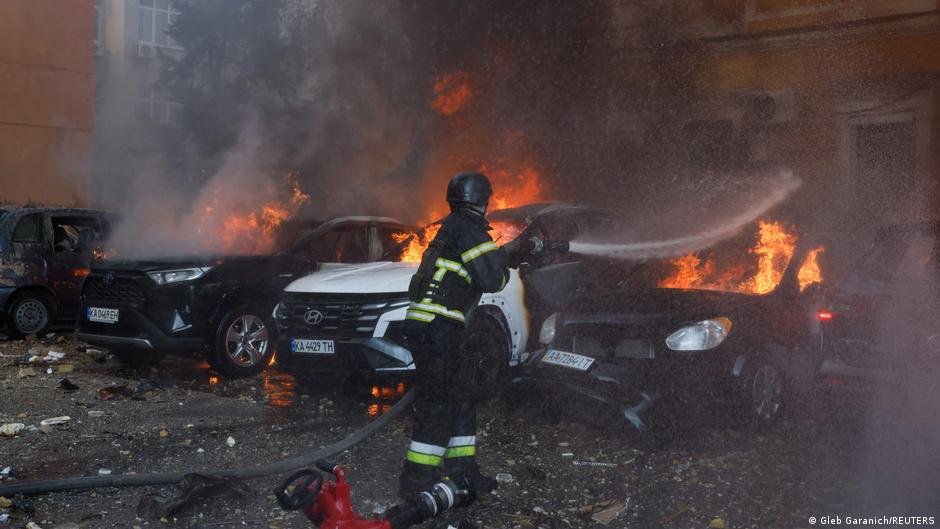
Russian forces renewed their attack on Kyiv overnight into Tuesday, 29 September, striking the Ukrainian capital with ballistic missiles and unmanned aerial vehicles after a day of deadly attacks in the city centre. For British and European policymakers, investors and companies with exposure to the region, the latest assault underlines the persistence of war risk on the EU’s eastern flank and the pressure it continues to place on security planning, energy assumptions and market sentiment.
Kyiv Mayor Vitali Klitschko said debris from a ballistic missile fell in the courtyard of a residential building in the Solomianskyi district. He said there was no fire at that location. No information was reported about deaths or injuries from the overnight strikes.
“In the Solomianskyi district, missile debris fell in the courtyard of a house. There is no fire. In the Pecherskyi district, there is a fire in a three-storey non-residential building,” Klitschko wrote on Telegram.
Klitschko later clarified that in the Solomianskyi district, a fire had broken out in one of the buildings of an educational institution after the strike. The Kyiv City Military Administration also reported that a drone had fallen onto a roadway. Officials separately reported a fire after debris fell onto the roof of a five-storey residential building in the Holosiivskyi district.
Pressure on Kyiv After Daytime Attacks
The overnight bombardment followed daytime Russian strikes in central Kyiv on 28 September. According to Klitschko, two people were killed in the city from the start of the day, and another 26 were wounded. He said eight of the injured required hospital treatment, with one person in serious condition.
Both fatalities were linked to a drone strike on the building of Ukraine’s National Academy of Sciences. The attack triggered a major fire, leaving people trapped inside the building. Many were forced to escape through windows. Another Russian strike hit the Dobrobut medical centre building.
The pattern of attacks, moving from daytime strikes in central Kyiv to renewed overnight missile and drone fire, points to continuing pressure on Ukraine’s capital despite sustained Western military and financial backing. The incidents also highlight the civilian and institutional targets exposed by the campaign, including an academic institution, a medical centre, residential areas, an educational building and city infrastructure.
Why It Matters for Britain and Europe
For the UK and the European Union, Kyiv’s vulnerability remains a central strategic and economic concern. Britain has been among Ukraine’s most prominent supporters, while EU governments continue to manage the consequences of the war across defence budgets, energy policy, refugee support and sanctions enforcement. Each fresh attack on the Ukrainian capital reinforces the political case in London and European capitals for maintaining military assistance and economic pressure on Moscow.
The business implications are less direct but still material. Investors in London and across Europe have treated the war as a recurring geopolitical risk factor since Russia’s full-scale invasion. Attacks on Kyiv can sharpen attention on defence stocks, energy security, transport routes and the outlook for reconstruction-linked investment. They also add to the background risks that can influence sterling and euro sentiment, particularly when markets are already sensitive to inflation, borrowing costs and government spending commitments.
No specific market moves were reported in the source information following the latest strikes. Still, for the City of London, the broader issue is familiar: escalation in Ukraine can feed risk aversion, support demand for perceived safer assets and complicate assumptions about European growth. Sterling’s reaction to Ukraine-related headlines typically depends on the wider market backdrop, including energy prices, UK rates expectations and global dollar strength.
For European companies, the renewed attacks are another reminder that operational risk in Ukraine remains high. Businesses involved in logistics, humanitarian supply chains, infrastructure, energy services and future reconstruction planning must factor in continuing air-raid disruption, damage to urban facilities and the possibility of sudden escalation. The strikes on a scientific institution and a medical centre also show how damage can extend beyond military facilities into sectors essential to civil society and long-term economic recovery.
Civilian Infrastructure in the Line of Fire
The reported locations of debris and impact points across Kyiv show the breadth of disruption caused by missile and drone attacks. Officials described debris near a residential building, a fire in a non-residential three-storey building, a drone falling on a roadway, debris landing on the roof of a five-storey building and a fire in an educational facility. During the earlier daytime attacks, the National Academy of Sciences building was hit by a drone and the Dobrobut medical centre building was also struck.
For European governments, these details matter because they shape the diplomatic narrative around the war. The targeting or damaging of civilian and institutional sites strengthens Ukraine’s appeals for air defence systems and sustained Western assistance. It also keeps Russia’s conduct under scrutiny among allies debating the future scale and pace of support.
The absence of reported overnight casualties does not reduce the seriousness of the assault. Kyiv had already suffered fatalities and injuries earlier in the day, and officials described fires, trapped civilians and emergency conditions at multiple locations. The continuation of attacks through the night suggests a sustained attempt to pressure the capital and stretch emergency response capacity.
As of the reports cited by city officials, the toll from 28 September stood at two dead and 26 injured in Kyiv, with eight hospitalised and one in serious condition. The overnight strikes added further damage reports but no confirmed deaths or injuries. For the UK and EU, the immediate question is humanitarian and security-related; for markets, it is whether the latest escalation remains a contained geopolitical shock or becomes part of a wider deterioration in regional risk.