Uzbekistan ID Card Fee Debate Deepens as Regional Gaps Draw Scrutiny
A dispute over first-time identity card charges is spotlighting household strain in Uzbekistan and widening the contrast with cheaper regional systems.
A row over the price of a first identity card in Uzbekistan has moved from social media into a wider debate over household affordability and state charges, a question with clear interest for British and European business readers tracking consumer pressure in Central Asia. Any effect on sterling would be indirect, but the comparison with neighbouring systems can be read in London as a micro-level signal of administrative reform, living costs and the burden of official fees.
The discussion intensified after journalist Dilnoza Qurbonova described a scene at a local passport office involving a girl aged around 15 or 16 who had come to obtain an ID card for the first time with her father. Qurbonova drew attention to the family’s visible hardship, writing that once the cashier announced the amount due, the father’s hands began to shake as he opened his wallet and counted the money inside one note and coin at a time. The girl, she said, looked first at her father and then at the ground.
He opened his wallet and began counting even the last small coins one by one. In those seconds, seeing the father’s anguish and his daughter’s glance first at him and then at the ground made my heart ache, Qurbonova wrote.
The episode has pushed a broader question onto the agenda: how fair is the state duty charged for a child’s first identity document as they reach adulthood, and how do other countries approach the issue? A comparison across eight jurisdictions suggests Uzbekistan stands out for the size of the charge attached to a first ID card.
Fees tied to a rising benchmark
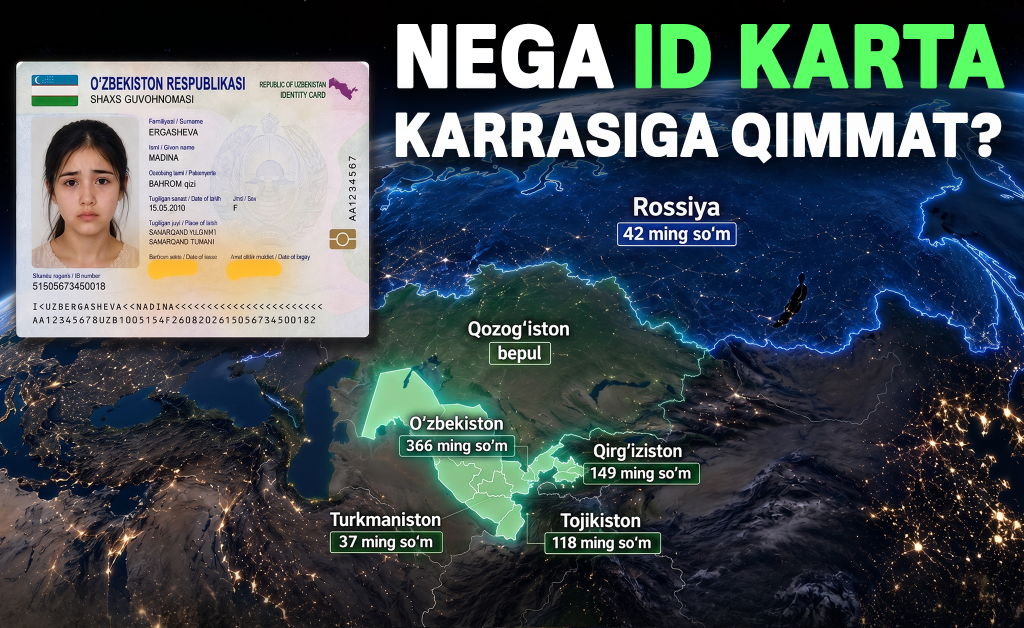
In Uzbekistan, the state duty for a first ID card depends on how the application is filed. If the request is made through the migration department, a public services centre or a consulate, the fee is set at 89% of the base calculation amount, known locally as the BHM. Since August 1, 2025, the BHM has been fixed at 412,000 Uzbek sum, which puts the current charge for a first ID card at 366,680 sum.
Applicants who file online through my.gov.uz pay slightly less: 80.1% of the BHM, or 330,012 sum at the current rate. The sensitivity to the benchmark matters because the BHM is already scheduled to rise from 412,000 sum to 440,000 sum on September 1, 2026. If the fee percentages remain unchanged, the duty for applications made through the migration department, public services centres or consulates will increase to 391,600 sum, while the online fee will climb to 352,440 sum. For European readers, including sterling-based investors, that makes the issue less about a single administrative charge than about how fixed public fees escalate alongside official benchmarks.
Regional comparisons sharpen the debate
Neighbouring and nearby states use markedly different models. In Kazakhstan, from January 1, 2026, every citizen turning 16 can receive an ID card for the first time free of charge, and renewal after expiry is also free. The same exemption also applies to people obtaining the document for the first time after the age of 18, to new Kazakh citizens and in certain other cases. The stated goal is to reduce the financial burden on citizens and simplify the documentation process.
In Kyrgyzstan, citizens receiving an ID card for the first time can obtain it under the standard procedure within 12 working days for 1,103 Kyrgyz som, equivalent at the current rate to about $12.6 or 149,000 Uzbek sum. That means the standard first-time cost in Kyrgyzstan is roughly 2.5 times cheaper than Uzbekistan’s current 366,680-sum state duty. Tajikistan charges $10 to issue a citizen’s ID card, collected in the national currency, the somoni, at the exchange rate on the day of payment. Processing can take up to 15 days. At the official exchange rate published by the Central Bank of Uzbekistan on August 21, that $10 is about 118,000 Uzbek sum, or roughly 3.1 times cheaper than the fee now charged in Uzbekistan.
Turkmenistan does not issue a separate national ID card, with the biometric passport serving as the main identity document. According to the state migration service, the fee for issuing that biometric passport is 60 manat, equivalent at the black-market rate to about $3.2 or 37,000 Uzbek sum. Children under 16 are exempt from the payment, making the cost around 10 times lower than the charge currently faced in Uzbekistan. Russia issues an internal passport from the age of 14. The state duty for a first passport is set at 300 roubles, or around $3.6 and 42,000 Uzbek sum at the current rate, which is approximately 8.7 times cheaper than Uzbekistan’s first ID card fee. Under the Russian Tax Code, the 300-rouble duty applies both to a first issue and to scheduled replacement, while a lost or unusable passport costs 1,500 roubles to replace.
Turkey’s main identity document, the Türkiye Cumhuriyeti Kimlik Kartı, is priced at 220 Turkish lira in 2026, equal to about $5 or 59,000 Uzbek sum. But if a child’s birth is registered within the legal deadline and the first identity card is then issued, no payment is charged. Cards issued after the deadline or because of replacement cost 220 lira. In Azerbaijan, citizens receive an identity card from the age of 15. According to the interior ministry, the state duty for standard issuance within 10 days is 5 manat.
For London markets, this is unlikely to be a direct sterling-moving event. The relevance instead lies in what the debate says about the cost burden placed on households at a milestone moment of formal citizenship, and how that burden compares with peers across the region. For UK and EU businesses studying Central Asia, the pricing gap is a small but concrete indicator of disposable-income pressure, administrative design and the social sensitivity surrounding basic public services. Unless Uzbekistan changes the fee formula, the scheduled BHM increase on September 1, 2026 will make that contrast even sharper.