Western Retailers in Russia Face Asset Controls as EU Investors Watch Risk
Temporary management over Auchan, Leroy Merlin and Metro assets highlights growing exposure risks for European companies still tied to Russia.
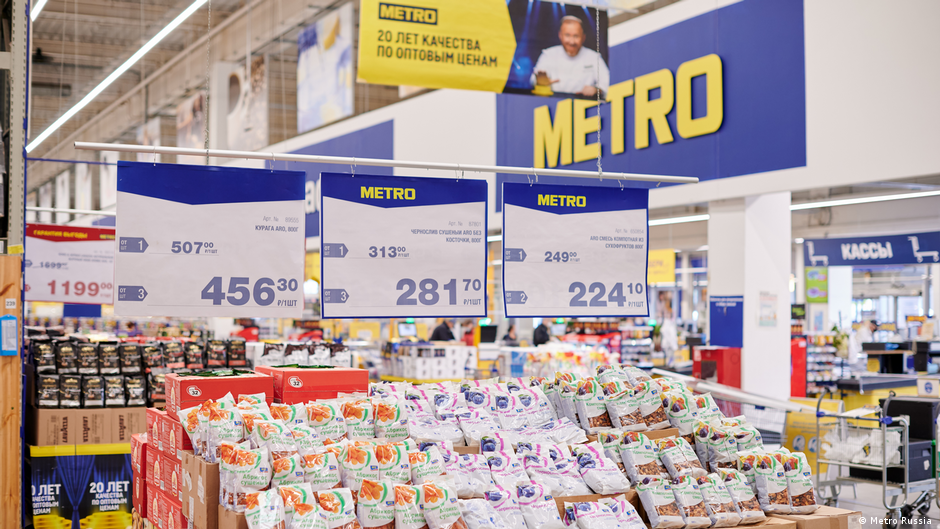
Foreign retail groups with operations in Russia are facing a tightening squeeze over their local assets, raising fresh questions for European business leaders, investors and policymakers about how much control Western companies can still exercise over businesses left inside the country.
According to the source report, temporary management has been introduced over assets linked to several foreign retail chains, including France’s Auchan and Leroy Merlin and Germany’s Metro. In some cases, owners have lost access to the assets. The developments have sharpened concerns that nationalisation, or measures with a similar practical effect, could become a larger risk for international retailers that have retained Russian exposure.
For British and European markets, the issue is not limited to the fate of individual store networks. It cuts into a broader question now familiar to boards in London, Paris, Berlin and other financial centres: whether remaining Russian assets can still be valued, controlled or exited on terms that investors would regard as commercially meaningful.
European retailers under pressure
The source article frames the situation around a central question: whether the Russian businesses of foreign retailers are at risk of nationalisation. It notes that assets belonging to some foreign-owned retail operations have already been placed under temporary management, with their owners deprived of access.
The affected names cited include major European retail and consumer-facing groups. Auchan and Leroy Merlin are French-linked brands with long-standing consumer recognition. Metro, the German wholesale and retail group, is also named among companies whose Russian assets have faced temporary management. The report refers more broadly to “other companies” as part of the same pattern.
For EU companies, temporary management can be as important as formal ownership on paper. Even without a completed nationalisation, the loss of operational control can affect governance, reporting, valuation and the ability to return funds to parent companies. That matters to European investors assessing whether Russian-linked assets should be treated as viable businesses, stranded assets or political liabilities.
The source also highlights the former Russian subsidiary of Germany’s Globus. It says former German chancellor Gerhard Schroeder has joined the supervisory board of the former Russian “daughter” company of the German holding. That detail gives the story an explicitly European political dimension, connecting corporate governance in Russia with one of Germany’s most recognisable former political figures.
Foreign retail chains are losing the ability to manage their assets in Russia one after another, according to the source report.
Why London will pay attention
Although the companies named in the report are French and German rather than British, the implications are relevant for the City of London. London-listed investors, lenders, insurers, advisers and fund managers have spent years reassessing Russian exposure across sectors. Retail is not usually seen as the most systemically sensitive category, but it is a highly visible part of the real economy and often carries significant property, supply chain and employment footprints.
For sterling-based investors, the risk is less about a direct currency shock from one retailer’s Russian assets and more about the way political risk feeds into European equity sentiment. If investors conclude that corporate assets in Russia can be taken out of foreign owners’ hands through temporary administration or similar measures, they may apply a deeper discount to any residual Russian exposure still sitting on European balance sheets.
Sterling’s response to such developments would normally depend on broader market conditions, including risk appetite, energy prices, interest-rate expectations and the relative performance of the euro. The source material does not provide market prices or exchange-rate moves, so no specific sterling reaction can be stated. But for UK desks, the story belongs in the same risk category as sanctions exposure, trapped capital and contested asset ownership.
London market reaction would therefore be expected to centre on disclosure quality and legal exposure rather than on consumer retail performance alone. Analysts are likely to look for whether companies with past or present Russian links can still consolidate, write down, sell, or otherwise account for those operations with confidence. Where access to assets has been lost, the accounting and governance questions become especially acute.
A warning for cross-border business
The report’s list of retailers also underlines a wider European business dilemma. Some companies exited Russia after the full-scale war in Ukraine began, while others sought to suspend, sell, restructure or reduce exposure. But where assets remain inside Russia, the ability to execute a clean exit may depend less on corporate preference than on the political and regulatory environment in Moscow.
Temporary management can leave foreign owners in a difficult middle ground. They may still be associated with the business internationally, while no longer being able to direct its operations in practice. That can create reputational questions in Europe and operational uncertainty in Russia at the same time.
The presence of Schroeder on the supervisory board of the former Russian Globus subsidiary, as cited in the source, adds another layer. Schroeder has long been a controversial figure in European debates over ties with Russia. His role in connection with the former Globus unit will be read in Europe not only as a governance appointment, but also as a signal of how Russian retail assets may seek political or institutional protection after Western owners lose influence.
For British and EU investors, the central lesson is straightforward: Russian consumer businesses once seen as stable cash-generating operations now carry a political risk profile that can overwhelm ordinary commercial analysis. Retailers depend on physical assets, local permits, distribution networks and staff. Those are precisely the kinds of assets that become vulnerable when control is contested.
The source does not state that all foreign retail assets in Russia have been nationalised, nor does it provide a definitive forecast. Its emphasis is on a process already under way: Western retailers are losing management control over Russian assets, and some owners no longer have access. For European boardrooms and London market participants, that is enough to keep Russian exposure firmly on the risk agenda.